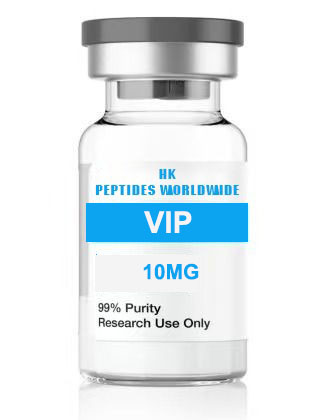
vip 10 mg
VIP 10 mg Research Peptide USA Overview of VIP 10 mg VIP ( Vasoactive Intestinal Peptide ) 10 mg is a high-purity neuropeptide supplied exclusively for laboratory and scientific research purposes in the United States. It is widely referenced in scientific literature for its role in neuropeptide signaling, receptor interaction, and cellular communication pathways . This 10 mg format is ideal for extended experimental protocols, comparative studies, and advanced laboratory investigations. This product is strictly for research use only (RUO) . Research Characteristics of VIP Neuropeptide Signaling and Receptor Research VIP is commonly studied in laboratory environments for its interaction with VPAC receptors (VPAC1 and VPAC2) and its involvement in cell signaling, neurotransmission, and regulatory pathway research . Laboratory-Grade Purity and Stability Manufactured using advanced peptide synthesis and purification processes, VIP 10 mg ensures high purity, stability, and reproducibility across professional research applications. Advanced Safe & Reliable Packaging Standards Each vial is packaged using professional laboratory-grade systems to ensure safety, stability, and integrity during storage and transport: Tamper-evident sealed vials to ensure authenticity Sterile, airtight containment to prevent contamination Shock-resistant protective packaging to reduce transit damage Temperature-stable materials to preserve peptide structure Clear, lab-compliant labeling for accurate identification and handling Designed to meet the expectations of research laboratories, biotech companies, and scientific professionals across the USA . Research Applications VIP 10 mg is commonly used in neuropeptide signaling research , receptor binding studies , cell communication analysis , and in-vitro biochemical modeling . Supplied strictly for laboratory and scientific research purposes only. Advantages and Limitations Advantages 10 mg format suitable for extended and repeatable research Widely referenced in neuropeptide and receptor studies Stable formulation for controlled laboratory environments Professional packaging ensures safety, integrity, and reliability Limitations Not approved for human or animal use No therapeutic, clinical, or diagnostic applications Restricted exclusively to scientific research settings Frequently Asked Questions (FAQ) 1. What type of research uses VIP 10 mg? VIP is commonly studied in neuropeptide signaling, receptor interaction, and cellular communication research models. 2. Is VIP 10 mg approved for medical or clinical use? No. This product is strictly for laboratory and in-vitro research purposes only. 3. What makes the packaging safe and reliable? It includes tamper-evident sealing, sterile containment, shock-resistant packaging, and temperature-stable materials to ensure product integrity.
Expanded Research Background & Molecular Mechanisms
Structural Identity & Pharmacological Classification
VIP (Vasoactive Intestinal Peptide) is supplied as a 10 mg research-grade lyophilized powder for controlled laboratory investigation. CAS: 37221-79-7. The molecular architecture — H-His-Ser-Asp-Ala-Val-Phe-Thr-Asp-Asn-Tyr-Thr-Arg-Leu-Arg-Lys-Gln-Met-Ala-Val-Lys-Lys-Tyr-Leu-Asn-Ser-Ile-Leu-Asn-NH2 — confers specific structural features that determine receptor binding kinetics, metabolic stability, and biological activity profiles relevant to preclinical research applications. Each batch is synthesized under strictly controlled solid-phase peptide synthesis (SPPS) conditions using Fmoc chemistry, purified via preparative reverse-phase HPLC, and verified through comprehensive analytical characterization including high-resolution mass spectrometry and amino acid analysis.
Primary Mechanism of Action
The biological activity of VIP is mediated through high-affinity interaction with its cognate receptor(s). Upon receptor engagement, conformational changes in the receptor-ligand complex trigger intracellular signaling cascades involving G-protein coupling, second messenger generation (cAMP, IP3, Ca²⁺), and downstream kinase activation. These signaling events culminate in transcriptional reprogramming of target genes through activation of transcription factors including CREB, NF-κB, and AP-1, depending on the specific receptor system and cell type under investigation. The concentration-response relationship typically follows classical sigmoidal kinetics with EC₅₀ values in the nanomolar to micromolar range, making VIP suitable for dose-response experimental designs across multiple biological replicate conditions.
Downstream Signaling & Cellular Responses
Research investigations have elucidated several key downstream pathways activated by VIP:
-
MAPK/ERK Cascade: Receptor activation → Ras → Raf → MEK → ERK1/2 phosphorylation → nuclear translocation → transcription of immediate-early genes (c-Fos, c-Jun, Egr-1) → cellular proliferation and differentiation responses. This pathway is particularly relevant in tissue remodeling, wound healing, and regenerative biology research contexts.
-
PI3K/Akt/mTOR Axis: Parallel signaling through PI3K → PIP₃ → PDK1 → Akt phosphorylation (Thr308, Ser473) → mTORC1 activation → enhanced protein translation via 4E-BP1 and S6K1 phosphorylation. This pathway supports anabolic signaling, cell survival, and metabolic reprogramming studies.
-
JAK/STAT Pathway: In cytokine-responsive systems, VIP-mediated receptor dimerization recruits JAK kinases → STAT protein phosphorylation → STAT dimerization → nuclear translocation → target gene transcription. This pathway is central to immunomodulation and hematopoietic research.
-
Calcium Mobilization: Gαq-coupled signaling → PLCβ activation → IP₃-mediated Ca²⁺ release from ER stores → calmodulin-dependent kinase (CaMK) activation → diverse cellular responses including secretion, contraction, and gene expression.
Pharmacokinetic Considerations for Research Design
For laboratory research applications, several pharmacokinetic parameters inform experimental design:
- Reconstitution: Lyophilized VIP should be reconstituted in sterile, preservative-free aqueous buffer (PBS pH 7.4 or sterile water) to the desired stock concentration. Gentle swirling — not vortexing — is recommended to prevent peptide aggregation and ensure complete dissolution.
- Stability: Reconstituted solutions maintain full biological activity for up to 30 days when stored at 2–8°C, protected from light. For extended storage, aliquot into single-use volumes and store at -20°C or -80°C. Avoid repeated freeze-thaw cycles, which can cause 3–8% activity loss per cycle due to peptide aggregation and potential oxidation of sensitive residues.
- Working Concentrations: Typical in vitro working concentrations range from 1 nM to 100 μM, depending on the assay system and experimental endpoint. Preliminary dose-ranging experiments (logarithmic dilution series: 0.1, 1, 10, 100, 1000 nM and 1, 10, 100 μM) are recommended to establish the optimal concentration range for each specific research application.
Comparative Pharmacology & Research Context
VIP occupies a distinct position within the broader peptide research landscape. Compared to structurally related compounds, VIP exhibits unique receptor selectivity profiles, signaling bias characteristics (G-protein vs. β-arrestin coupling), and pharmacokinetic properties that make it a valuable tool for dissecting specific biological pathways. Researchers should consider the following when designing comparative studies:
- Receptor Selectivity: Verify receptor specificity through competitive binding assays using pharmacologically relevant concentrations of selective antagonists.
- Signaling Bias: Quantify both G-protein-mediated (cAMP, IP₁ accumulation) and β-arrestin-mediated (receptor internalization, ERK phosphorylation) signaling to fully characterize functional selectivity.
- Batch Consistency: For multi-phase research programs spanning extended time periods, procure peptide from the same manufacturing batch to eliminate batch-to-batch variability as a confounding factor.
Quality Control Verification Protocol
Before initiating experimental procedures, researchers should verify:
- Peptide identity by mass spectrometry (observed MW within ±1.0 Da of theoretical)
- Purity ≥98% by analytical HPLC at 214 nm
- Peptide content ≥80% by quantitative amino acid analysis
- Endotoxin levels ≤1.0 EU/mg (critical for cell-based assays)
- Visual inspection: white to off-white lyophilized powder with no discoloration or clumping
These verification steps ensure experimental reproducibility and data integrity across research programs.
Related Research & Resources
| Resource | Description |
|---|---|
| Healing Regenerative Peptides Hub | Complete research overview & methodology hub |
| Vip 10 Mg Research Peptide Usa | Related research peptide product |
| Aicar 5 Mg Research Compound Usa | Related research peptide product |
| Peptides On The Rise Exploring The Newest Advances In Scientific Research | Latest research insights & methodology |