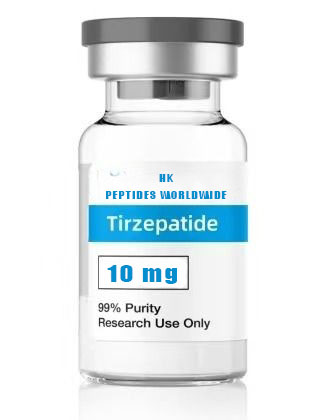
tirzepatide 10 mg
Tirzepatide 10 mg Research Peptide Vials (USA) — Comprehensive Product Overview Tirzepatide 10 mg is a research-grade dual GIP/GLP-1 receptor agonist peptide specifically formulated for laboratory and scientific research applications requiring moderate material quantities for dose-response studies, comparative pharmacology experiments, and screening campaigns. As the second-tier dosage in our Tirzepatide portfolio, the 10 mg vial provides researchers with twice the material of the entry-level 5 mg format, enabling expanded experimental designs without the commitment required for high-quantity vials. Tirzepatide (CAS: 2023788-19-2) is a synthetic 39-amino acid peptide amide (MW: 4813.5 Da) that has been extensively characterized in peer-reviewed pharmacological literature for its unique ability to simultaneously activate both the glucose-dependent insulinotropic polypeptide receptor (GIPR) and the glucagon-like peptide-1 receptor (GLP-1R). The full amino acid sequence — H-Tyr-Aib-Glu-Gly-Thr-Phe-Thr-Ser-Asp-Tyr-Ser-Ile-Aib-Leu-Asp-Lys-Ile-Ala-Gln-Lys(AEEA-AEEA-γ-Glu-eicosanedioic acid)-Ala-Phe-Val-Gln-Trp-Leu-Ile-Ala-Gly-Gly-Pro-Ser-Ser-Gly-Ala-Pro-Pro-Pro-Ser-NH2 — incorporates two strategically positioned α-aminoisobutyric acid (Aib) residues that confer resistance to DPP-4-mediated proteolysis, while the C20 fatty diacid moiety (eicosanedioic acid) conjugated via an AEEA-AEEA-γ-Glu linker at Lys20 provides the extended albumin-binding pharmacokinetics that make once-weekly dosing intervals feasible in preclinical models. At the 10 mg dosage, each vial contains sufficient material for approximately 3-6 complete dose-response curve experiments (depending on concentration range and replicate number), making it particularly well-suited for screening and optimization studies where multiple conditions must be tested simultaneously. The ≥99% HPLC-verified purity ensures that observed biological effects are attributable to Tirzepatide itself rather than peptide-related impurities, a critical consideration for publication-quality research. Each vial is manufactured under ISO-certified quality management with full lot traceability and batch-specific analytical documentation. This product is supplied exclusively for research use only (RUO) and is not intended for any human or veterinary clinical, diagnostic, or therapeutic application. Key Features 10 mg research vial — the ideal quantity for dose-response curve establishment, screening studies, and multi-condition experimental designs Dual GIP and GLP-1 receptor co-agonist — simultaneous activation of both incretin pathways for synergistic metabolic research outcomes ≥99% HPLC purity — every batch verified by analytical HPLC at 214 nm with complete chromatogram documentation Lyophilized powder for extended stability — stable at -20°C for 24+ months when stored in desiccated conditions Aib-stabilized α-helical structure — positions 2 and 13 feature non-proteinogenic Aib residues for DPP-4 resistance and enhanced receptor binding affinity C20 eicosanedioic acid albumin-binding moiety — enables extended pharmacokinetic half-life through high-affinity reversible albumin binding Batch-specific CoA available — HPLC purity data, mass spectrometry confirmation, and amino acid analysis for every production lot Optimized for screening, dose-response, receptor pharmacology, and comparative incretin studies The Science of Tirzepatide: Dual GIP/GLP-1 Receptor Pharmacology Tirzepatide’s molecular pharmacology is defined by its imbalanced dual agonism — the peptide exhibits approximately 5-fold greater potency at the GIP receptor relative to native GIP, while maintaining GLP-1 receptor potency roughly equivalent to endogenous GLP-1. This pharmacological profile is the product of rational peptide engineering: the native GIP sequence serves as the structural scaffold, onto which GLP-1-like activity and extended pharmacokinetics were systematically introduced. The two Aib residues (positions 2 and 13) are critical design elements — Aib is a helix-promoting, non-proteinogenic amino acid that stabilizes the α-helical conformation essential for high-affinity receptor engagement. By replacing the native Ala2 and Ile13 with Aib, the peptide backbone adopts a more rigid helical structure that simultaneously resists DPP-4 cleavage (which requires a flexible N-terminal conformation) and enhances binding affinity at both GIPR and GLP-1R. The C20 fatty diacid moiety conjugated at Lys20 serves a dual purpose: it provides the albumin-binding capacity necessary for extended pharmacokinetic duration (reducing renal clearance by exploiting the size-exclusion properties of the albumin carrier), while the length of the linker and fatty acid chain have been optimized to permit receptor activation without steric interference. Structure-activity relationship (SAR) studies have demonstrated that shorter fatty acid chains (C16, C18) result in reduced albumin binding and shorter duration, while longer chains or alternative linker chemistries can compromise receptor binding affinity. The 10 mg research vial is particularly valuable for receptor pharmacology studies because it provides sufficient material to characterize both GIPR and GLP-1R binding parameters (Ki, Bmax, association and dissociation kinetics) in parallel, enabling direct comparison of receptor engagement profiles. Researchers can use surface plasmon resonance (SPR), radioligand binding, or fluorescence polarization assays to quantify Tirzepatide’s binding characteristics at each receptor subtype, assess competitive displacement of native ligands (GIP and GLP-1), and evaluate functional selectivity (biased agonism) by comparing G-protein versus β-arrestin signaling outputs. Research Applications Tirzepatide 10 mg is optimized for the following laboratory research applications: Dose-response curve establishment — the 10 mg quantity enables comprehensive concentration-response experiments across both GIPR and GLP-1R signaling endpoints using cAMP accumulation (Hithunter, GloSensor), β-arrestin recruitment (BRET, PathHunter, Tango), and downstream phosphorylation (pCREB, pERK, pAKT) assays; Screening and lead optimization studies — evaluating Tirzepatide analogs, peptide conjugates, or formulation variants in head-to-head comparisons using standardized receptor activation protocols; Receptor binding and kinetic studies — SPR (Biacore), bio-layer interferometry (Octet), and radioligand binding assays to determine equilibrium binding constants, kinetic rate parameters (ka, kd), and residence time at human and rodent GIPR and GLP-1R; Comparative incretin pharmacology — side-by-side evaluation of Tirzepatide, Semaglutide, native GIP, native GLP-1, and other incretin peptides across a panel of functional assays to characterize potency, efficacy, and signaling bias; Islet biology research — glucose-stimulated insulin secretion (GSIS) assays in isolated mouse, rat, or human islets with dose-ranging Tirzepatide to establish EC50 values and maximum insulinotropic responses; Adipocyte and hepatocyte metabolic studies — evaluating Tirzepatide’s effects on lipogenesis, lipolysis, glucose uptake, and insulin sensitivity in 3T3-L1 adipocytes, primary human adipocytes, HepG2 hepatocytes, and primary hepatocyte cultures; In vivo pilot pharmacokinetics — using the 10 mg quantity to conduct preliminary PK studies in rodent models, measuring plasma concentrations by LC-MS/MS to establish Cmax, Tmax, t1/2, and AUC parameters. Comparative Analysis: Tirzepatide vs. Semaglutide vs. Retatrutide The incretin peptide landscape offers researchers three distinct pharmacological tools: Semaglutide (GLP-1R-selective agonist): As a single-receptor agonist, Semaglutide activates GLP-1R without engaging GIPR. This makes Semaglutide an appropriate control compound when researchers need to isolate GLP-1R-specific effects from GIPR-mediated contributions. However, Semaglutide cannot replicate the synergistic metabolic benefits of dual-receptor activation — particularly the GIPR-mediated enhancement of adipocyte insulin sensitivity, lipid buffering, and β-cell functional potentiation that are hallmarks of Tirzepatide pharmacology. In head-to-head preclinical comparisons, Tirzepatide consistently outperforms Semaglutide in weight reduction, glycemic improvement, and lipid profile optimization at equimolar doses. Tirzepatide (dual GIP/GLP-1R agonist): Positioned between single and triple agonism, Tirzepatide provides a clean experimental system for studying GIP-GLP-1 synergy without the confounding influence of glucagon receptor (GCGR) activity. This intermediate complexity makes Tirzepatide the preferred tool for researchers who want to investigate GIP biology in the context of GLP-1 co-stimulation. The 10 mg vial size is particularly well-suited for comparative studies that require parallel testing of multiple incretin peptides across identical assay formats, enabling statistically robust comparisons of potency, efficacy, and signaling profiles. Retatrutide (GIP/GLP-1R/GCGR triple agonist): By adding GCGR activation, Retatrutide introduces glucagon-mediated energy expenditure, hepatic fatty acid oxidation, and amino acid metabolism — endpoints that may be scientifically interesting but also introduce experimental variables (hyperglycemia risk, altered hepatic function, changes in nitrogen balance) that can complicate data interpretation. For researchers whose primary interest is the GIP-GLP-1 axis without glucagon-related confounds, Tirzepatide offers a more focused pharmacological tool. The 10 mg Tirzepatide vial enables cost-effective comparative studies across all three incretin peptides, supporting comprehensive pharmacological profiling of the incretin receptor landscape. Disclaimer This product is intended exclusively for laboratory research purposes only. It is not approved by the FDA or any other regulatory authority for human or veterinary diagnostic, therapeutic, clinical, or prophylactic use. Purchasers must be qualified researchers affiliated with recognized laboratories, universities, biotechnology companies, or research institutions. By purchasing this product, the buyer acknowledges and agrees to use it solely for legitimate scientific research in compliance with all applicable laws, regulations, and institutional guidelines. Product Specifications Product Name: Tirzepatide CAS Number: 2023788-19-2 Molecular Formula: C225H348N48O68 Molecular Weight: 4813.5 Da Sequence: H-Tyr-Aib-Glu-Gly-Thr-Phe-Thr-Ser-Asp-Tyr-Ser-Ile-Aib-Leu-Asp-Lys-Ile-Ala-Gln-Lys(AEEA-AEEA-γ-Glu-eicosanedioic acid)-Ala-Phe-Val-Gln-Trp-Leu-Ile-Ala-Gly-Gly-Pro-Ser-Ser-Gly-Ala-Pro-Pro-Pro-Ser-NH2 Purity: ≥99% (HPLC, 214 nm) Strength: 10 mg per vial Form: Sterile lyophilized powder Grade: Research Use Only (RUO) Solubility: Soluble in aqueous buffers (PBS, pH 7.4) and organic solvents (DMSO, DMF) for research purposes Storage: Store lyophilized powder at -20°C; after reconstitution, store aliquots at -20°C or -80°C and avoid repeated freeze-thaw cycles Quality Assurance & Analytical Testing Every batch of Tirzepatide 10 mg undergoes comprehensive analytical characterization: HPLC Purity at 214 nm — ≥99% purity verified with full chromatogram documentation; Mass Spectrometry (ESI-MS) — molecular weight confirmation within ±1.0 Da of theoretical 4813.5 Da; Amino Acid Analysis (AAA) — compositional verification confirming correct amino acid ratios; Peptide Content by Nitrogen Determination — ensuring stated peptide mass per vial; Endotoxin Testing (LAL Method) — quantified endotoxin levels for cell-based and in vivo research suitability; Residual Solvent Analysis (GC-HS) — verification that manufacturing solvents are below ICH Q3C limits; Appearance and Reconstitution Testing — confirming proper lyophilized cake morphology and complete reconstitution characteristics. Certificates of Analysis (CoA) are available upon request and include all relevant analytical data. Handling & Storage Guidelines Lyophilized powder storage: store unopened vials at -20°C in a desiccated environment; lyophilized Tirzepatide is stable for 24+ months; Reconstitution for research: dissolve in sterile PBS (pH 7.4), 0.1% acetic acid, or research-grade DMSO as appropriate; for a 1 mg/mL stock solution, add 10 mL of solvent to the 10 mg vial; Aliquot strategy: after reconstitution, dispense into single-use aliquots to avoid repeated freeze-thaw; store at -20°C (1-4 weeks) or -80°C (up to 6 months); Working solution stability: reconstituted Tirzepatide (1 mg/mL in PBS) retains ≥95% activity for 7 days at 4°C; prepare fresh working dilutions daily for optimal results; Handling: always use aseptic technique in a biosafety cabinet; wear appropriate PPE; ensure all glassware and solvents are sterile and pyrogen-free for cell-based or in vivo protocols. USA Shipping & Availability Fast USA domestic shipping — orders processed within 1-2 business days from US-based fulfillment centers; Temperature-controlled shipping with insulated packaging and cold packs; Professional, discreet laboratory-grade packaging preserving product integrity during transit; Available to qualified research laboratories, universities, biotechnology companies, and accredited institutions across the United States; International shipping available to select countries for qualified research institutions; Bulk and wholesale pricing available upon request for multi-vial orders and recurring supply arrangements. Why Choose Our Tirzepatide 10 mg? The optimal screening quantity — 10 mg provides the ideal balance of experimental capacity and cost-efficiency for dose-response and multi-condition studies; Verified ≥99% HPLC purity with full analytical traceability; Dual GIP/GLP-1 receptor agonist pharmacology enabling synergistic incretin research impossible with single-receptor tools; Complete molecular documentation including CAS number, full sequence with modification details, and molecular weight verification; Batch-specific quality control with CoA available upon request; Trusted by academic, biotech, and pharmaceutical researchers across the USA; Competitive pricing with volume discounts for multi-vial orders. Advantages and Limitations Advantages: Ideal quantity for comprehensive dose-response, screening, and comparative incretin pharmacology studies; Dual-receptor agonism provides experimental access to synergistic GIP-GLP-1 biology; High purity (≥99% HPLC) minimizes confounding variables from peptide-related impurities; Sufficient material for multiple parallel assay formats and replicate experiments; Comprehensive analytical documentation supports publication-quality research. Limitations: Not intended for clinical, diagnostic, or therapeutic applications; Requires proper laboratory handling, aseptic technique, and controlled storage; May be insufficient for extended in vivo studies requiring chronic dosing — researchers should consider 30 mg, 50 mg, or 60 mg vials for such protocols; Bioactivity must be independently validated in each laboratory’s specific experimental system. Frequently Asked Questions (FAQs) Q: Is Tirzepatide 10 mg FDA-approved? A: No. This product is exclusively for laboratory research use and is not approved for human or veterinary clinical applications. Q: Who can purchase this product? A: Qualified researchers, laboratories, universities, and accredited research institutions with verified research affiliations. Q: Do you ship within the USA? A: Yes, rapid domestic USA shipping is available from our US-based fulfillment centers. Q: What analytical documentation accompanies the product? A: Product information sheets are included; batch-specific CoAs with HPLC, MS, and AAA data are available upon request. Q: What is the recommended storage? A: Lyophilized: -20°C (24+ months stable). Reconstituted: aliquot and store at -20°C or -80°C; avoid freeze-thaw cycles. Q: How does Tirzepatide differ from Semaglutide? A: Tirzepatide activates both GIP and GLP-1 receptors (dual agonist), whereas Semaglutide targets only GLP-1R. This dual mechanism produces synergistic metabolic effects beyond GLP-1R activation alone. Q: Is bulk pricing available? A: Yes, contact our sales team for volume-based pricing on multi-vial orders and institutional supply agreements. Q: Can this product be used for in vivo research? A: Yes, within approved IACUC or equivalent institutional protocols, using appropriate preparation and aseptic technique. Q: How many experiments can I perform with a 10 mg vial? A: Approximately 3-6 complete dose-response experiments, depending on concentration range, replicate number, and assay format. Exact yields depend on specific experimental design parameters. Q: Is every batch purity-verified? A: Yes, every production batch undergoes HPLC purity analysis with a ≥99% acceptance criterion, along with MS and AAA verification. Ordering Information Visit hkpeptides.net to order Tirzepatide 10 mg research peptide vials. We accept institutional purchase orders, credit cards, and wire transfers. For technical inquiries, bulk pricing, or custom peptide requests, contact our scientific sales team who can assist with product specifications, shipping logistics, and volume quotations. HK Peptides Worldwide is committed to providing the highest-quality research peptides to the scientific community.
Related Research & Resources
| Resource | Description |
|---|---|
| Glp 1 Metabolic Peptides Hub | Complete research overview & methodology hub |
| High Purity Tirzepatide 50Mg | Related research peptide product |
| Tirzepatide 10 Mg Research Peptide Vials | Related research peptide product |
| Glp 1 Peptides Metabolic Research | Latest research insights & methodology |