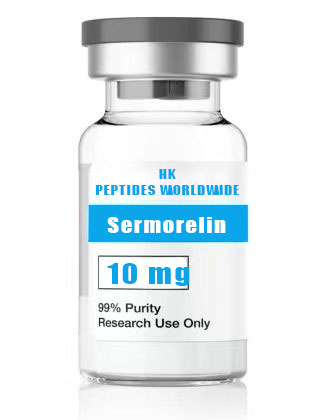
Sermorelin (GHRH 1-29 amide, GRF 5 mg + 10 mg
Growth Hormone ResearchReviewed by: HKPEPTIDE WORLDWIDE Research Team | Last Updated: 2026-08-08 | Document ID: HKPW-sermorelin-5-mg-10-mg-research-grade-ghrh-v1.0
1. Product Identity & Specifications
Sermorelin (GHRH 1-29 amide, GRF 1-29 NH₂) is the synthetic 29-amino acid N-terminal fragment of human growth hormone-releasing hormone (GHRH, also known as growth hormone-releasing factor, GRF). Extensive structure-activity relationship studies conducted in the 1980s established that the full GH-releasing potency of the native 44-amino acid GHRH resides within the N-terminal 29 residues, with the C-terminal 15 residues (30-44) contributing primarily to plasma stability rather than receptor pharmacology. Sermorelin thus represents the minimal fully active GHRH pharmacophore.
HKPEPTIDE WORLDWIDE supplies Sermorelin acetate as a lyophilized powder in two configurations: 5 mg for pilot pituitary pharmacology studies, and 10 mg for extended GH secretion research protocols. Sermorelin is the reference GHRH receptor agonist—FDA-approved as Geref® (1997) for diagnostic evaluation of pituitary GH secretory capacity—and serves as the essential positive control compound for GHRH receptor pharmacology, GH secretion assays, and GH axis research across pituitary cell models.
The C-terminal amidation (Arg²⁹-NH₂, replacing the native Arg²⁹-OH) provides dual benefits: (1) resistance to carboxypeptidase degradation, extending effective half-life; and (2) enhanced receptor binding through elimination of the C-terminal negative charge, which improves electrostatic complementarity with the GHRH receptor’s extracellular domain. This amidation, combined with the strategic truncation at residue 29, produces a peptide with approximately 20-minute plasma half-life (compared to ~7 minutes for native GHRH 1-44) while retaining full receptor potency (EC₅₀ ~0.5 nM for GH release).
| Parameter | Specification |
|---|---|
| Product Name | Sermorelin (GHRH 1-29 amide, GRF 1-29 NH₂) |
| CAS Number | 86168-78-7 |
| Molecular Formula | C₁₄₉H₂₄₆N₄₄O₄₂S |
| Molecular Weight | 3358.0 Da |
| Amino Acid Sequence | H-Tyr¹-Ala²-Asp³-Ala⁴-Ile⁵-Phe⁶-Thr⁷-Asn⁸-Ser⁹-Tyr¹⁰-Arg¹¹-Lys¹²-Val¹³-Leu¹⁴-Gly¹⁵-Gln¹⁶-Leu¹⁷-Ser¹⁸-Ala¹⁹-Arg²⁰-Lys²¹-Leu²²-Leu²³-Gln²⁴-Asp²⁵-Ile²⁶-Met²⁷-Ser²⁸-Arg²⁹-NH₂ |
| Residue Count | 29 amino acids |
| Available Configurations | 5 mg and 10 mg per vial |
| Appearance | White to off-white lyophilized powder |
| Purity | ≥98% by RP-HPLC |
| Solubility | ≥5 mg/mL in sterile water or 0.9% saline; soluble in PBS (pH 7.0–7.4) |
| Storage (Lyophilized) | -20°C, desiccated, protected from light |
| Storage (Reconstituted) | 2–8°C (≤14 days); aliquoted at -20°C (≤3 months) |
| Product Grade | Research Use Only (RUO) |
| Peptide Content | ≥85% net peptide basis |
2. Research Background
The discovery of growth hormone-releasing hormone in 1982 by the teams of Roger Guillemin (Salk Institute) and Wylie Vale (Salk Institute)—working independently on extracts from pancreatic tumors causing acromegaly—resolved a centuries-old question of how the hypothalamus controls pituitary GH secretion. Guillemin and Vale isolated and sequenced GHRH from a human pancreatic islet cell tumor that had caused acromegaly in the patient. The tumor-derived peptide was identical in sequence to hypothalamic GHRH, confirming the long-suspected existence of a hypothalamic GH-releasing factor. Guillemin had previously shared the 1977 Nobel Prize for his work on another hypothalamic-releasing factor (GnRH, then called LHRH), and the discovery of GHRH completed the triumvirate of hypothalamic hypophysiotropic hormones controlling the anterior pituitary (TRH, GnRH, GHRH, plus the inhibitory somatostatin discovered in 1973).
The native GHRH is a 44-amino acid peptide with an amidated C-terminus (GHRH 1-44-NH₂). It is synthesized in the arcuate nucleus of the hypothalamus, transported axonally to the median eminence, and released into the hypophyseal portal circulation in a pulsatile pattern that drives the ultradian rhythm of GH secretion. Between GHRH pulses, somatostatin (GHIH, growth hormone-inhibiting hormone, from the periventricular nucleus) tonically suppresses GH release, creating the characteristic interpulse troughs. The interplay between GHRH stimulatory pulses and somatostatin inhibitory tone generates the sexually dimorphic, species-specific GH secretory pattern—pulsatile in males (high-amplitude, low-frequency) and more continuous in females (low-amplitude, high-frequency).
Sermorelin was developed through systematic N-terminal and C-terminal truncation analysis of GHRH. The key findings were: (a) the N-terminal tyrosine (Tyr¹) is essential—deamidated or acetylated Tyr¹ abolishes activity; (b) truncation from the C-terminus to residue 29 retains full receptor potency, but truncation beyond residue 27 causes progressive loss of activity; (c) C-terminal amidation extends half-life without affecting potency; (d) the fragment (1-29)-NH₂ represents the optimal balance of activity and stability. These SAR studies, conducted primarily at the Salk Institute and Tulane University, established Sermorelin as the reference GHRH agonist and led to its FDA approval for diagnostic use in 1997.
For the research community, the 5 mg configuration supports pilot GH secretion experiments, receptor binding assays, and dose-response optimization; the 10 mg configuration supports comprehensive GH axis research, combination studies with somatostatin analogs and GHRPs, and multi-timepoint secretory dynamics analyses.
3. Molecular Mechanisms
3.1 GHRH Receptor Pharmacology
The GHRH receptor (GHRHR) is a class B (secretin family) G-protein-coupled receptor expressed almost exclusively on anterior pituitary somatotrophs. Class B GPCRs are characterized by a large N-terminal extracellular domain (ECD, ~120 residues) containing six conserved cysteine residues forming three disulfide bonds, a conserved hormone-binding fold, and a juxtamembrane domain (J-domain) that connects the ECD to the first transmembrane helix. Sermorelin binding follows the “two-domain” model: (1) the C-terminal region of Sermorelin (residues ~20-29) interacts with the ECD of GHRHR, providing high-affinity capture; (2) the N-terminal region (residues 1-10, particularly Tyr¹, Asp³, Ile⁵) engages the transmembrane bundle of the receptor, triggering the conformational change that activates intracellular signaling.
GHRHR couples to Gαs (the stimulatory G-protein α-subunit), activating adenylyl cyclase and elevating intracellular cAMP. In addition, GHRHR couples to Gαq/11, activating phospholipase C (PLC), which hydrolyzes PIP₂ to IP₃ (mobilizing intracellular Ca²⁺ from the endoplasmic reticulum) and DAG (activating PKC). The cAMP/PKA and Ca²⁺/PKC pathways converge on the transcription factor CREB (cAMP response element-binding protein), which binds to the cAMP response element (CRE) in the GH gene promoter and the GHRHR gene promoter, driving both GH secretion and somatotroph proliferation.
3.2 GH Secretion: cAMP-Dependent and cAMP-Independent Pathways
Sermorelin binding to GHRHR triggers GH secretion through two temporally and mechanistically distinct pathways. The cAMP/PKA-dependent pathway is responsible for sustained GH secretion: PKA phosphorylates and activates the voltage-gated L-type Ca²⁺ channel (CaV1.2/1.3), permitting sustained Ca²⁺ influx that triggers GH-containing secretory vesicle exocytosis. PKA also phosphorylates and sensitizes the IP₃ receptor on the ER, priming intracellular Ca²⁺ stores for release. The cAMP-independent pathway (Gαq/PLC) provides the initial rapid Ca²⁺ spike: IP₃ opens ER Ca²⁺ channels (IP₃R), releasing a pulse of Ca²⁺ that triggers an initial burst of GH exocytosis. The subsequent sustained Ca²⁺ signal depends on L-type channel-mediated Ca²⁺ influx activated by the PKA arm. Both pathways are required for the full amplitude and duration of the physiological GH secretory pulse.
3.3 Somatostatin Antagonism
Sermorelin-induced GH secretion is physiologically regulated by somatostatin (SST, also known as somatotropin release-inhibiting factor, SRIF), which acts through somatostatin receptors (SSTR1-5, primarily SSTR2 and SSTR5 on somatotrophs). Somatostatin receptors are Gαi-coupled, and their activation inhibits adenylyl cyclase, reducing cAMP and opposing the primary GHRHR signaling cascade. This antagonism is functional rather than competitive: somatostatin does not compete with Sermorelin for receptor binding but instead counteracts the downstream signaling consequences of GHRHR activation.
The physiological significance of this antagonism is profound. GH is secreted in pulses (every 3-4 hours in humans) rather than continuously because somatostatinergic tone oscillates, with troughs in somatostatin release corresponding to GHRH-driven GH pulses. Research protocols investigating Sermorelin pharmacology must account for this physiological antagonism: addition of somatostatin or stable somatostatin analogs (octreotide, lanreotide) to pituitary cell cultures suppresses Sermorelin-stimulated GH release; conversely, somatostatin receptor antagonists (CYN 154806) enhance Sermorelin potency.
3.4 GH Synthesis and Somatotroph Proliferation
Beyond triggering acute GH secretion, GHRHR activation by Sermorelin stimulates GH gene transcription and somatotroph proliferation. The GH gene promoter contains a cAMP response element (CRE) that binds phosphorylated CREB, and a pituitary-specific transcription factor binding site for Pit-1 (POU1F1). GHRHR signaling enhances Pit-1 expression through a positive autoregulatory loop: cAMP/PKA → CREB → Pit-1 promoter → Pit-1 protein → GH promoter transactivation. Chronic Sermorelin exposure (days to weeks in culture) increases somatotroph number and cellular GH content—effects that distinguish GHRH analogs from direct GH supplementation, which does not expand somatotroph reserve capacity.
3.5 Methionine Oxidation and Stability Considerations
Sermorelin contains a single oxidation-sensitive methionine residue at position 27 (Met²⁷). Methionine oxidation to methionine sulfoxide (Met(O)) reduces GHRHR binding affinity by approximately 5-10 fold and is the primary degradation pathway during storage. Oxidation is catalyzed by ambient oxygen, light, and trace metal ions (particularly Fe²⁺ and Cu²⁺). HKPEPTIDE WORLDWIDE packages Sermorelin under inert atmosphere (argon) to minimize pre-shipment oxidation, and recommends researchers avoid exposure to ambient oxygen, store lyophilized product at -20°C, and use sterile, degassed water for reconstitution.
4. Research Applications & Focus Areas
The 5 mg and 10 mg Sermorelin configurations are suited for:
- GHRH Receptor Pharmacology: Radioligand binding (¹²⁵I-Sermorelin), competition binding with GHRH analogs, and functional cAMP accumulation assays; comparison with native GHRH(1-44)-NH₂
- GH Secretion Assays: Primary rat/human anterior pituitary cell cultures, GH3 and GH4C1 pituitary cell lines; ELISA/RIA quantification of GH release
- Somatostatin Interaction Studies: Co-administration of Sermorelin with somatostatin, octreotide, or pasireotide; quantitative analysis of functional antagonism
- GH Axis Modeling: Mathematical modeling of pulsatile GH secretion; characterization of GHRH pulse amplitude, frequency, and somatostatin interpulse dynamics
- GHRH/GHRP Synergy Studies: Sermorelin + GHRP-2, GHRP-6, or Ipamorelin combinations; quantification of synergistic GH release compared with additive predictions
- CJC-1295 Comparison: Comparative pharmacology of Sermorelin vs. CJC-1295 (both with and without DAC); receptor binding affinity, cAMP potency, and GH release time-course differences
- IGF-1 Feedback Studies: Examination of IGF-1 negative feedback on GHRH-stimulated GH release; somatostatin-dependent vs. somatostatin-independent feedback mechanisms
- Circadian and Ultradian Rhythm Research: Characterization of GHRH pulse generator physiology; sleep-GH relationship studies
5. Quality Control & Analytical Specifications
| Test | Method | Acceptance Criteria |
|---|---|---|
| Purity | RP-HPLC (C18 column, 214 nm) | ≥98.0% |
| Molecular Weight | ESI-MS | 3358.0 ± 1.0 Da |
| Sequence Confirmation | LC-MS/MS Peptide Mapping (trypsin + Glu-C) | ≥95% coverage |
| Methionine Oxidation | RP-HPLC (Met(O)-Sermorelin resolved) | Met(O) ≤2.0% |
| Peptide Content | Amino Acid Analysis (AAA) | ≥85.0% |
| TFA Content | Ion Chromatography | ≤1.0% |
| Water Content | Karl Fischer Titration | ≤5.0% |
| Endotoxin | LAL Kinetic Chromogenic | ≤1.0 EU/mg |
| Appearance | Visual Inspection | White to off-white powder |
| Biological Activity | cAMP accumulation (GH3 cells, 100 nM, 30 min) | ≥5-fold induction vs. basal |
6. Sermorelin vs. CJC-1295 and Other GHRH Analogs: Comparative Analysis
Sermorelin (GHRH 1-29 NH₂), CJC-1295 (GHRH 1-29 with DAC-conferring modifications), and tesamorelin (GHRH 1-44 with a trans-3-hexenoic acid moiety) represent an evolutionary progression in GHRH analog design. Sermorelin: shortest plasma half-life (~20 min), minimal albumin binding, ideal for acute GH secretion studies and pulsatile delivery research; simplest structure, most economical synthesis; FDA-approved as Geref®. CJC-1295 without DAC: identical GHRHR pharmacology to Sermorelin but with four amino acid substitutions (D-Ala², Gln⁸, Ala¹⁵, Leu²⁷) that confer ~7-day half-life; ideal for sustained GH elevation studies. CJC-1295 with DAC: contains a maleimidopropionic acid moiety conjugated to Lys side chain that covalently binds serum albumin (Cys³⁴), extending half-life to ~8 days. Tesamorelin: retains full GHRH 1-44 sequence with N-terminal hexenoic acid modification; FDA-approved for HIV-associated lipodystrophy (Egrifta®). Researchers should select the GHRH analog appropriate for the research question: Sermorelin for acute pharmacology and pulsatility; CJC-1295 variants for sustained elevation; tesamorelin for translational research.
7. Tiered Wholesale Pricing
| Quantity | 5 mg Price | 10 mg Price | SKU |
|---|---|---|---|
| 1 Vial | $75.00 | $125.00 | HKPW-SERMORELIN-5MG / HKPW-SERMORELIN-10MG |
| 5 Vials | $67.50/vial ($337.50) | $112.50/vial ($562.50) | Multi-pack |
| 10 Vials | $60.00/vial ($600.00) | $100.00/vial ($1,000.00) | Multi-pack |
| 25+ Vials | Contact for bulk | Contact for bulk | HKPW-SERMORELIN-BULK |
All prices in USD. Academic and institutional discounts available.
8. Frequently Asked Questions
Q: Why is Sermorelin’s Tyr¹ essential?
Tyr¹ of GHRH/Sermorelin is absolutely required for receptor activation. N-terminal acetylation, deamination, or deletion of Tyr¹ reduces GH-releasing activity by >99%. The Tyr¹ side chain interacts with a critical pocket in the GHRHR transmembrane domain, and its free α-amine forms a hydrogen bond network essential for the conformational change that couples ligand binding to G-protein activation. This absolute requirement is a hallmark of class B GPCR peptide agonists—the N-terminus of the peptide ligand functions as the “message” segment while the C-terminal helix functions as the “address” segment providing high-affinity receptor capture.
Q: How can I verify Sermorelin biological activity in my assays?
We recommend an acute GH release assay using primary rat anterior pituitary cells or GH3/GH4C1 cell lines. Treat with 10⁻¹⁰–10⁻⁷ M Sermorelin for 15-60 minutes, then quantify GH in the culture supernatant by species-specific ELISA or RIA. Expected EC₅₀ values: 0.3–1.0 nM. For receptor-level confirmation, measure cAMP accumulation (competitive ELISA or FRET-based biosensor) with an EC₅₀ of 0.1–0.5 nM in GHRHR-expressing cells. Both assays are recommended for complete pharmacological characterization.
Q: What distinguishes Sermorelin from GHRP-2 and GHRP-6?
Sermorelin is a GHRH receptor agonist (class B GPCR, cAMP/PKA signaling). GHRP-2 and GHRP-6 are ghrelin receptor (GHS-R1a) agonists (class A GPCR, Gαq/PLC/IP₃ signaling). These receptors are co-expressed on somatotrophs but converge on GH secretion through different second messenger systems: cAMP/PKA (GHRHR) vs. IP₃/Ca²⁺/PKC (GHS-R1a). Combined activation produces synergistic (>additive) GH release, a phenomenon extensively studied in GH axis research. Sermorelin + GHRP combinations also differentially engage the hypothalamic GHRH/somatostatin feedback loop compared with either agent alone.
Q: Does Sermorelin affect other pituitary hormones?
At concentrations producing maximal GH release (1-100 nM), Sermorelin does not significantly stimulate the release of prolactin, TSH, LH, FSH, or ACTH from anterior pituitary cells. GHRHR expression is highly restricted to somatotrophs, conferring exquisite target selectivity. This contrasts with GHRPs/GHS-R1a agonists, which can stimulate prolactin and ACTH release at higher concentrations through off-target receptor activation or hypothalamic effects.
9. References & Further Reading
- Guillemin R, et al. Growth hormone-releasing factor from a human pancreatic tumor that caused acromegaly. Science. 1982. (The GHRH discovery paper — PMID: 6285480)
- Rivier J, et al. Characterization of a growth hormone-releasing factor from a human pancreatic islet tumor. Nature. 1982. (The Vale laboratory’s independent GHRH characterization — PMID: 6289128)
- Ling N, et al. Isolation, primary structure, and synthesis of human hypothalamic somatocrinin: growth hormone-releasing factor. PNAS. 1984. (Hypothalamic GHRH characterization)
- Frohman LA, Kineman RD. Growth hormone-releasing hormone: discovery, regulation, and actions. In: Handbook of Physiology, The Endocrine System. 2002. (Comprehensive GHRH review)
- Batch-specific Certificate of Analysis (COA) with every order
- Full HPLC chromatogram and ESI-MS spectrum available upon request
- Technical dossier provided with bulk wholesale orders
10. Internal Resources
- Research Peptide Quality Guide
- COA and Quality Standards
- Shipping & Handling Information
- Contact Our Research Team
11. Compliance Statement
FOR LABORATORY RESEARCH USE ONLY. This product is intended exclusively for in vitro and preclinical laboratory research and scientific investigation. Not for human or veterinary diagnostic, therapeutic, or prophylactic use. Not a dietary supplement, pharmaceutical ingredient, or approved drug substance. Sermorelin is classified as a prohibited substance by the World Anti-Doping Agency (WADA) under category S2 (Peptide Hormones, Growth Factors, and Related Substances). Sermorelin acetate was FDA-approved as Geref® (NDA 019863) for diagnostic use; the HKPEPTIDE WORLDWIDE product is not Geref® and is not intended for diagnostic use. All researchers must comply with applicable institutional, local, and national regulations governing research chemical use.
Related Research & Resources
| Resource | Description |
|---|---|
| Healing Regenerative Peptides Hub | Complete research overview & methodology hub |
| Sermorelin 10 Mg Molecular Research Pept | Related research peptide product |
| Sermorelin 5 Mg 10 Mg Research Grade Ghr | Related research peptide product |
| Why Muscle Growth Peptide Research Is Expanding | Latest research insights & methodology |
View Complete Research Guide »
© 2026 HKPEPTIDE WORLDWIDE. All rights reserved. Document ID: HKPW-sermorelin-5-mg-10-mg-research-grade-ghrh-v1.0