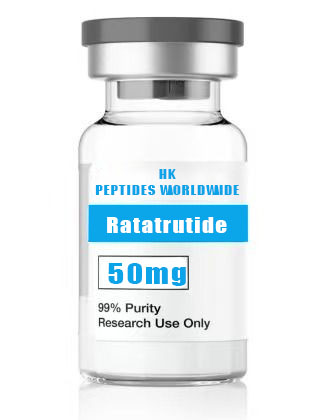
retatrutide 50 mg
Technical Specifications
| Parameter | Value |
|---|---|
| Product Name | Retatrutide (LY3437943) |
| CAS Number | 2381089-83-2 |
| Molecular Formula | C₂₂₃H₃₄₃N₅₅O₆₈ |
| Molecular Weight | ~4845.5 Da |
| Dosage | 50 mg per vial |
| Purity | ≥98% (HPLC-verified) |
| Appearance | White to off-white lyophilized powder |
| Solubility | Soluble in aqueous buffer solutions |
| Storage | -20°C, protected from light and moisture |
| Pharmacological Class | Triple GIP/GLP-1/GCGR receptor agonist |
| Supplier | HK Peptides Worldwide |
| Intended Use | Laboratory and scientific research only |
Product Overview
Retatrutide 50 mg is a research-grade synthetic peptide supplied exclusively for large-scale laboratory and scientific investigation. This product represents the penultimate tier in HK Peptides Worldwide’s eight-dosage Retatrutide portfolio, positioned within the institutional-scale range of the product line. With ten times the research material of the 5 mg entry-level format, the 50 mg vial is purpose-engineered for high-throughput screening facilities, large core laboratories, multi-departmental research initiatives, industrial research and development programs, and institutional peptide repositories requiring substantial quantities of well-characterized reference material from a single manufacturing batch.
Retatrutide (LY3437943) is a structurally optimized unimolecular triple agonist peptide that simultaneously engages and activates the glucose-dependent insulinotropic polypeptide (GIP) receptor, glucagon-like peptide-1 (GLP-1) receptor, and glucagon (GCGR) receptor. The peptide’s molecular architecture—a 39-amino acid sequence with a conjugated C20 fatty diacid moiety—achieves balanced agonism across all three class B GPCRs that collectively regulate glucose homeostasis, lipid metabolism, energy expenditure, and body weight. With a molecular weight of approximately 4845.5 Daltons, Retatrutide’s design incorporates structural features that support both multi-receptor pharmacology and extended duration of receptor engagement through reversible albumin binding.
The 50 mg format is designed for organizations operating at the leading edge of multi-receptor agonist research. At this scale, the peptide supports: comprehensive high-throughput screening campaigns involving tens of thousands of assay wells; multi-year, multi-investigator research programs distributed across departments or institutions; industrial-scale analytical method development and validation; extensive forced degradation and stability studies under diverse stress conditions; and the establishment of institutional reference standards for triple agonist research. The 50 mg format provides the research continuity, batch consistency, and cost efficiency required for programs where peptide material is a foundational resource supporting multiple concurrent investigations.
Each batch of Retatrutide 50 mg is manufactured under strictly controlled conditions using solid-phase peptide synthesis with Fmoc chemistry, purified by preparative HPLC, and verified through comprehensive analytical characterization including HPLC purity assessment (≥98%) and high-resolution mass spectrometry identity confirmation. HK Peptides Worldwide distributes this product exclusively for in-vitro research applications to qualified research institutions. It is categorically not intended for human consumption, veterinary use, clinical treatment, or diagnostic procedures.
Molecular Mechanism and Research Background
Frontier Topics in Triple Agonist Pharmacology
At the 50 mg institutional research scale, investigators typically engage with frontier pharmacological questions that demand substantial quantities of well-characterized peptide. The following advanced research themes represent appropriate applications:
Structural Biology of Multi-Receptor Complexes: Understanding the molecular details of how Retatrutide interacts simultaneously or sequentially with its three target receptors requires structural biology approaches including cryo-electron microscopy (cryo-EM) of peptide-receptor complexes, X-ray crystallography of receptor extracellular domains in complex with Retatrutide, and hydrogen-deuterium exchange mass spectrometry (HDX-MS) to map conformational dynamics. These techniques require milligram quantities of highly pure peptide.
Receptor-Receptor Interactions and Signal Integration: An emerging frontier in GPCR pharmacology is the investigation of how co-expressed receptors influence each other’s signaling through physical interactions (heterodimerization/oligomerization), competition for shared signaling components, or convergent regulation of downstream effectors. Retatrutide’s triple agonist activity makes it an ideal tool for investigating these phenomena among GIPR, GLP-1R, and GCGR.
Epigenetic and Transcriptional Consequences of Sustained Multi-Receptor Activation: Large-scale “omics” approaches—transcriptomics, proteomics, metabolomics—require sufficient peptide to treat cell populations over extended periods, enabling comprehensive characterization of the cellular reprogramming that results from sustained triple receptor agonism. The 50 mg format supports these resource-intensive experimental designs.
In Vitro Disease Modeling and Phenotypic Screening: Advanced in vitro models including 3D organoid cultures, microfluidic organ-on-chip systems, and co-culture models incorporating multiple cell types enable more physiologically relevant investigation of Retatrutide’s multi-receptor pharmacology. These complex experimental systems consume larger quantities of peptide than traditional 2D cell culture, and the 50 mg format ensures adequate supply for comprehensive phenotypic characterization.
Research Characteristics
Premium-Grade Research Material
Retatrutide 50 mg is verified against the most stringent purity criteria in the product portfolio, with ≥98% purity by RP-HPLC at 214 nm. The analytical methodology employs high-resolution chromatography with optimized gradient conditions to resolve the parent peptide from all detectable impurities. High-resolution mass spectrometry provides identity confirmation with mass accuracy within 5 ppm. Peptide content is determined to enable accurate preparation of experimental solutions at known concentrations.
Industrial-Scale Manufacturing Quality
The 50 mg format benefits from manufacturing processes validated at production scale. Solid-phase peptide synthesis is performed with real-time coupling efficiency monitoring to ensure complete amino acid incorporation at each cycle. Preparative HPLC purification utilizes optimized parameters developed through process characterization studies. The final lyophilization cycle produces a powder with excellent flow properties, rapid reconstitution characteristics, and low residual moisture content.
Bulk Packaging Configuration
The 50 mg vial utilizes appropriately sized USP Type I borosilicate glass with a closure system validated for long-term frozen storage. The nitrogen headspace filling process is controlled to ensure consistent inert atmosphere protection. Packaging components are selected for low extractable profiles, and the sealed vial configuration has been demonstrated to maintain peptide integrity throughout the labeled shelf life under recommended storage conditions.
Research Applications
Large-Scale High-Throughput Screening
The 50 mg format supports industrial-scale HTS applications:
- Screening against panels of thousands of GPCRs for comprehensive selectivity profiling
- Dose-response profiling across extensive receptor mutant libraries
- Combination screening with large compound collections for drug interaction studies
- Phenotypic screening in complex cellular models for novel biological activity detection
Multi-Departmental Collaborative Research
For research institutions where multiple departments or research groups collaborate on Retatrutide-related projects, the 50 mg format provides centralized batch material that can be distributed across the collaborative network. This approach:
- Ensures all groups use identical peptide material
- Simplifies quality documentation and compliance
- Leverages economies of scale for cost efficiency
- Facilitates cross-departmental data integration and meta-analysis
Comprehensive Stability and Formulation Programs
The 50 mg quantity supports exhaustive stability and formulation development:
- ICH-compliant stability studies under long-term, intermediate, and accelerated conditions
- Multiple stress conditions (heat, light, oxidation, pH extremes, mechanical stress)
- Excipient compatibility screening across diverse formulation vehicles
- Container-closure compatibility studies
- Forced degradation for stability-indicating method validation
Institutional Reference Standard Programs
Organizations developing institutional reference standards for triple agonist research can utilize the 50 mg format to establish well-characterized reference material with comprehensive analytical documentation, supporting method calibration, system suitability testing, and inter-laboratory harmonization.
Comparative Dosage Analysis
Institutional-Scale Comparison: 50 mg vs. Alternatives
| Parameter | 40 mg | 50 mg | 60 mg |
|---|---|---|---|
| Baseline Multiple | 8× | 10× | 12× |
| Aliquot Yield (5 mg) | 8 | 10 | 12 |
| Aliquot Yield (10 mg) | 4 | 5 | 6 |
| Multi-Dept Capability | 3-4 depts | 5 depts | 6 depts |
| HTS Wells (est.) | 4,000-8,000 | 5,000-10,000 | 6,000-12,000 |
| Cost Efficiency | Very Good | Excellent | Best |
Why 50 mg Is the Institutional Workhorse:
The 50 mg format provides the round-number capacity (10× baseline) that simplifies resource planning and distribution logistics. For institutions serving five research groups, 50 mg provides straightforward 10 mg per group allocation. For ten groups, 5 mg each. This mathematical simplicity facilitates budgeting, inventory management, and distribution planning.
Advantages and Limitations
Advantages
- Ten-Fold Baseline Capacity: Ten times the research material of the 5 mg format for institutional-scale programs.
- Unique Research Tool: Only commercially available triple GIP/GLP-1/GCGR agonist peptide.
- ≥98% Purity: Verified purity supporting the most demanding research applications.
- Institutional Distribution Optimization: Round-number capacity simplifies allocation planning.
- HTS at Scale: Supports high-throughput campaigns of 5,000-10,000+ assay wells.
- Batch Consistency: Multi-year programs conducted with identical peptide material.
- Comprehensive Documentation: Full analytical characterization and traceability.
Limitations
- Research Use Only: Restricted to laboratory scientific investigation.
- In-Vitro Research Focus: Supplied and validated for in-vitro applications.
- Reconstitution Required: Lyophilized format requires aseptic processing.
- Storage Requirements: Consistent -20°C storage essential for stability.
- Not a Pharmacopeial Standard: High purity but not certified as an official reference.
- Regulatory Responsibility: Users bear full institutional and regulatory compliance responsibility.
Quality Assurance, Storage, and Compliance
Comprehensive release testing: HPLC purity ≥98%, ESI-MS identity (MW 4845.5 ± 1.0 Da), peptide content by AAA, residual TFA ≤1.0%, residual solvents per ICH Q3C, endotoxin ≤1.0 EU/mg, bioburden ≤100 CFU/g. Store unopened vials at -20°C; reconstituted aliquots at -20°C or -80°C. Research Use Only—not FDA-approved, no therapeutic claims. Institutional compliance responsibility.
Frequently Asked Questions (FAQ)
1. What is Retatrutide’s CAS number? CAS 2381089-83-2. Molecular weight ~4845.5 Da.
2. Why 50 mg instead of 40 mg or 60 mg? 50 mg provides 10× baseline capacity with round-number distribution simplicity—ideal for institutions serving 5 or 10 research groups.
3. How many aliquots from 50 mg? Ten 5 mg aliquots, five 10 mg aliquots, or custom combinations.
4. What receptors does Retatrutide target? GIP, GLP-1, and glucagon receptors—balanced triple agonism.
5. What purity is guaranteed? ≥98% by HPLC.
6. Is 50 mg suitable for industrial HTS? Yes, supports 5,000-10,000+ assay wells.
7. How should I store 50 mg? -20°C for vials; aliquoted solutions at -20°C or -80°C.
8. Can 50 mg serve a multi-department collaboration? Yes, ideal for 5-10 research groups.
9. Is Retatrutide approved for human use? No. Research use only.
10. How do I order? Contact HK Peptides Worldwide at hkpeptides.net.
Related Research & Resources
| Resource | Description |
|---|---|
| Glp 1 Metabolic Peptides Hub | Complete research overview & methodology hub |
| Retatrutide 10 Mg Scientific Research Ma | Related research peptide product |
| Retatrutide 15 Mg Laboratory Peptide Sup | Related research peptide product |
| Glp 1 Peptides Metabolic Research | Latest research insights & methodology |
View Complete Research Guide »
Disclaimer: Retatrutide 50 mg is a research chemical exclusively for laboratory investigation. No therapeutic claims are made or implied.