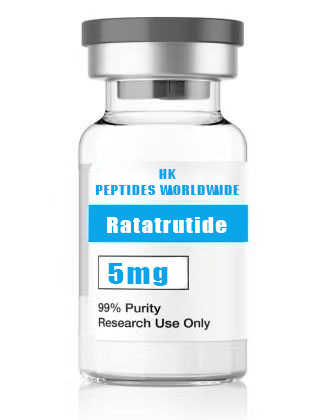
retatrutide 5 mg
Technical Specifications
| Parameter | Value |
|---|---|
| Product Name | Retatrutide (LY3437943) |
| CAS Number | 2381089-83-2 |
| Molecular Formula | C₂₂₃H₃₄₃N₅₅O₆₈ |
| Molecular Weight | ~4845.5 Da |
| Dosage | 5 mg per vial |
| Purity | ≥98% (HPLC-verified) |
| Appearance | White to off-white lyophilized powder |
| Solubility | Soluble in aqueous buffer solutions |
| Storage | -20°C, protected from light and moisture |
| Pharmacological Class | Triple GIP/GLP-1/GCGR receptor agonist |
| Supplier | HK Peptides Worldwide |
| Intended Use | Laboratory and scientific research only |
Product Overview
Retatrutide 5 mg is a research-grade synthetic peptide supplied exclusively for controlled laboratory investigation and scientific research applications. This product represents the entry-level configuration within HK Peptides Worldwide’s comprehensive Retatrutide research portfolio, which spans eight graduated dosage strengths from 5 mg to 60 mg. The 5 mg format is specifically engineered to serve as an economical, precision-oriented option for preliminary studies, pilot experiments, method development, receptor binding assays, and dose-response curve establishment in in-vitro research environments.
Retatrutide (also known by its developmental code LY3437943) is a groundbreaking unimolecular triple agonist peptide that simultaneously targets and activates three distinct receptors: the glucose-dependent insulinotropic polypeptide (GIP) receptor, the glucagon-like peptide-1 (GLP-1) receptor, and the glucagon (GCGR) receptor. This unique triple-agonist mechanism represents a significant advancement in peptide pharmacology research, differentiating Retatrutide from single and dual agonist peptides that have been the focus of metabolic research for decades. The 5 mg vial quantity provides researchers with sufficient material for multiple controlled experiments while maintaining cost efficiency for exploratory investigative protocols.
This product is manufactured under strict quality-controlled laboratory conditions, with each batch undergoing rigorous analytical verification including high-performance liquid chromatography (HPLC) purity assessment and mass spectrometry confirmation of molecular identity. HK Peptides Worldwide distributes Retatrutide 5 mg strictly for in-vitro research purposes and explicitly states that this product is not intended for human consumption, veterinary applications, clinical treatment, or diagnostic procedures. All research involving this peptide must be conducted in accordance with applicable institutional, local, and national regulations governing laboratory research materials.
Molecular Mechanism and Research Background
Triple Agonist Pharmacology
Retatrutide’s molecular architecture enables simultaneous engagement of three class B G protein-coupled receptors (GPCRs) that play fundamental roles in metabolic homeostasis. The peptide has been rationally designed with a 39-amino acid sequence incorporating specific structural modifications, including a fatty acid side chain conjugated via a linker to facilitate albumin binding and extend the peptide’s research-relevant half-life in experimental models. The molecular weight of approximately 4845.5 Daltons reflects this engineered structure, which incorporates both the peptide backbone and the fatty acid moiety essential for its pharmacokinetic profile.
GIP Receptor (GIPR) Agonism: GIP is an incretin hormone secreted by intestinal K-cells in response to nutrient ingestion. Research has demonstrated that GIP receptor activation stimulates insulin secretion in a glucose-dependent manner, enhances lipid metabolism in adipose tissue, and may exert protective effects on pancreatic beta-cell function. The GIP component of Retatrutide’s activity profile is of particular research interest because unlike GLP-1 receptor agonism, GIP receptor activation has been associated with minimal gastrointestinal adverse effects in experimental models, potentially contributing to an improved tolerability profile.
GLP-1 Receptor (GLP-1R) Agonism: GLP-1 receptor activation is well-characterized in metabolic research for its effects on glucose-dependent insulin secretion, suppression of glucagon release, delayed gastric emptying, and central nervous system-mediated satiety signaling. The GLP-1 component of Retatrutide contributes to the peptide’s effects on glycemic parameters and body weight regulation in research models.
Glucagon Receptor (GCGR) Agonism: The inclusion of glucagon receptor activity distinguishes Retatrutide from all currently marketed single and dual agonist peptides. GCGR activation promotes hepatic glucose production, lipolysis, and increased energy expenditure. In the context of Retatrutide’s balanced triple agonism, the glucagon component is hypothesized to enhance lipid oxidation and energy expenditure while the concurrent GIP and GLP-1 activities mitigate potential hyperglycemic effects, resulting in a net metabolic benefit in research models.
Structural Design Considerations
Retatrutide’s sequence has been computationally optimized to achieve a specific activity ratio across the three target receptors. The peptide backbone is derived from the native GIP sequence with strategic amino acid substitutions that confer balanced agonism at all three receptors. A C20 fatty diacid moiety is conjugated to the peptide via a hydrophilic linker at a specific lysine residue, enabling reversible binding to serum albumin and extending the peptide’s duration of action in experimental settings. This structural feature is critical for research applications requiring sustained receptor engagement over extended observation periods.
Research Characteristics
High-Purity Laboratory Material
Every batch of Retatrutide 5 mg undergoes comprehensive analytical characterization to ensure suitability for rigorous scientific investigation. Purity is verified by reverse-phase high-performance liquid chromatography (RP-HPLC) with a minimum acceptance criterion of ≥98%. Molecular identity is confirmed through liquid chromatography-mass spectrometry (LC-MS), and peptide content is quantified so that the stated quantity of material present in each vial is verified. Residual solvent analysis, endotoxin testing, and bioburden assessment are performed according to established laboratory quality standards.
Controlled Manufacturing Environment
Retatrutide 5 mg is synthesized using solid-phase peptide synthesis (SPPS) methodology followed by purification and lyophilization under controlled environmental conditions. The manufacturing process is conducted by certified peptide production facilities that adhere to standardized operating procedures designed to ensure batch-to-batch consistency and traceability. Each production batch is assigned a unique lot number, and comprehensive certificates of analysis (CoA) are maintained for quality documentation purposes.
Protective Packaging and Stability
Each 5 mg vial is packaged in USP Type I borosilicate glass with a bromobutyl rubber stopper and aluminum crimp seal to protect the lyophilized peptide from moisture, oxygen, and light exposure. Vials are stored and shipped under temperature-controlled conditions to maintain peptide integrity. Researchers are advised to store unopened vials at -20°C in a desiccated environment and to protect reconstituted solutions from repeated freeze-thaw cycles.
Research Applications
In-Vitro Receptor Binding Studies
Retatrutide 5 mg is particularly well-suited for in-vitro receptor binding and activation assays designed to characterize the peptide’s affinity and efficacy at GIP, GLP-1, and GCGR receptors. Researchers may employ competitive binding assays using radiolabeled or fluorescently labeled ligands, cAMP accumulation assays to quantify receptor activation, and β-arrestin recruitment assays to evaluate biased signaling properties. The 5 mg quantity provides sufficient material for multiple assay replicates and concentration-response curve generation.
Cell-Based Functional Assays
This peptide can be utilized in cell-based experimental systems expressing individual or multiple target receptors. Applications include measurement of intracellular signaling cascades (cAMP, Ca²⁺ mobilization, ERK phosphorylation), evaluation of receptor internalization and trafficking dynamics, and assessment of downstream transcriptional responses. Cell lines commonly employed in such studies include HEK293, CHO, and INS-1 cells transfected with relevant receptor constructs.
Comparative Pharmacology Research
Retatrutide 5 mg serves as an essential reference compound for comparative pharmacological studies examining differences among GLP-1 receptor agonists (e.g., semaglutide, liraglutide), dual GIP/GLP-1 receptor agonists (e.g., tirzepatide), and the novel triple agonist class. Such comparative investigations contribute to the fundamental understanding of multi-receptor pharmacology and inform the rational design of next-generation peptide therapeutics.
Analytical Method Development
The 5 mg vial format is ideal for laboratories engaged in developing and validating analytical methods for peptide characterization. Applications include HPLC method optimization, mass spectrometry protocol development, stability-indicating assay validation, and forced degradation studies to establish peptide stability profiles under various stress conditions.
Pilot and Exploratory Studies
As the smallest dosage in the Retatrutide product range, the 5 mg format enables researchers to conduct preliminary investigations, screen experimental conditions, and validate assay systems before committing to larger quantities. This approach supports efficient resource utilization and methodical experimental design.
Comparative Dosage Analysis
Retatrutide 5 mg vs. Higher Dosage Strengths
The 5 mg dosage represents the entry point in HK Peptides Worldwide’s Retatrutide product line, and its selection should be guided by specific research objectives. The following comparative analysis contextualizes the 5 mg format within the broader product range:
| Feature | 5 mg | 10 mg | 15 mg | 20 mg | 30 mg | 40 mg | 50 mg | 60 mg |
|---|---|---|---|---|---|---|---|---|
| Best For | Pilot studies, method dev. | Expanded pilots | Moderate-scale studies | Standard research | Mid-scale projects | Extended protocols | Large-scale studies | High-throughput |
| Assay Count | ~50-100 assays | ~100-200 assays | ~150-300 assays | ~200-400 assays | ~300-600 assays | ~400-800 assays | ~500-1000 assays | ~600-1200 assays |
| Cost Efficiency | Lowest absolute cost | Good entry value | Balanced | Optimal balance | Strong value | High value | Bulk savings | Maximum economy |
| Protocol Fit | Preliminary | Exploratory | Confirmatory | Standardized | Repetitive | Extended | Production-scale | Industrial-scale |
When to Select Retatrutide 5 mg:
- Initial receptor binding screening and assay qualification
- Method development and analytical validation protocols
- Educational and training laboratory exercises
- Pilot experiments requiring minimal peptide consumption
- Research groups new to triple agonist investigation
- Laboratories with limited peptide storage capacity
- Comparative studies where small quantities of reference standard are needed
When to Consider Higher Dosages:
- Established protocols requiring multiple experimental replicates
- Long-term research programs with predictable consumption rates
- High-throughput screening campaigns
- Studies requiring multiple concentration ranges in parallel
- Collaborative multi-investigator research projects
Retatrutide vs. Other Metabolic Research Peptides
Retatrutide’s triple agonist mechanism distinguishes it qualitatively from other peptides in the metabolic research category:
vs. Semaglutide (GLP-1R Mono-Agonist): Retatrutide engages two additional receptor systems (GIPR and GCGR) beyond GLP-1R alone, providing researchers with a more complex pharmacological tool for investigating multi-receptor interactions in metabolic pathways.
vs. Tirzepatide (GIP/GLP-1R Dual Agonist): While tirzepatide is a dual GIP/GLP-1 receptor agonist, Retatrutide adds GCGR activity, enabling investigation of glucagon-mediated effects on energy expenditure and lipid metabolism that cannot be studied with dual agonists alone.
vs. Liraglutide/Semaglutide: Retatrutide’s fatty acid conjugation strategy is conceptually related to the acylation approaches used in liraglutide (C16) and semaglutide (C18), but the specific C20 fatty diacid moiety in Retatrutide has been optimized for the triple agonist’s unique pharmacokinetic requirements.
Advantages and Limitations
Advantages
- Novel Triple Agonist Mechanism: Retatrutide 5 mg provides researchers access to the only commercially available research-grade triple GIP/GLP-1/GCGR receptor agonist, enabling investigation of pharmacological mechanisms not accessible with single or dual agonists.
- High Purity (≥98%): HPLC-verified purity ensures reliable and reproducible experimental results, minimizing confounding factors attributable to peptide impurities.
- Economical Entry Point: The 5 mg format offers the lowest absolute cost within the Retatrutide product line, reducing barriers to initiating triple agonist research.
- Comprehensive Quality Documentation: Each batch is accompanied by analytical data supporting identity, purity, and content claims.
- Flexible Research Tool: Suitable for a wide range of in-vitro applications from binding assays to functional cell-based studies.
- Consistent Manufacturing: Solid-phase peptide synthesis under controlled conditions ensures batch-to-batch reproducibility.
- Temperature-Controlled Distribution: Protective packaging and cold-chain logistics maintain peptide integrity during transit.
Limitations
- Not for Human or Veterinary Use: This product is restricted exclusively to laboratory and scientific research applications. It is not approved for therapeutic, clinical, or diagnostic purposes.
- In-Vitro Research Only: Retatrutide 5 mg is supplied for in-vitro experimentation and is not validated for in-vivo animal studies without appropriate institutional approvals and regulatory compliance measures.
- Reconstitution Required: As a lyophilized powder, the peptide requires reconstitution in an appropriate solvent prior to use, introducing a variable that must be controlled in experimental design.
- Storage Sensitivity: Peptide stability is dependent on proper storage at -20°C with protection from moisture and light. Improper storage may result in degradation and compromised experimental data.
- Regulatory Restrictions: Researchers are responsible for ensuring that their use of this product complies with all applicable laws, regulations, and institutional policies governing research materials.
- Limited Stability in Solution: Reconstituted peptide solutions have finite stability and should be used promptly or aliquoted and stored at appropriate temperatures to maintain activity.
Quality Assurance and Analytical Methods
Purity Analysis
Retatrutide 5 mg is subjected to rigorous purity assessment using reverse-phase high-performance liquid chromatography (RP-HPLC) with UV detection at 214 nm and 280 nm. The chromatographic method employs a C18 column with a water/acetonitrile gradient containing 0.1% trifluoroacetic acid (TFA). Purity is reported as the percentage of the total peak area attributable to the Retatrutide peak, with a minimum acceptance criterion of ≥98.0%.
Identity Confirmation
Molecular identity is confirmed through electrospray ionization mass spectrometry (ESI-MS) operated in positive ion mode. The observed mass-to-charge ratio (m/z) envelope is deconvoluted to determine the molecular weight, which must fall within the expected range of 4845.5 ± 1.0 Da. The isotopic distribution pattern provides additional confirmation of molecular identity.
Peptide Content Determination
Quantitative amino acid analysis (AAA) or nitrogen content determination is performed to establish the net peptide content of the lyophilized powder, correcting for residual water, counterions, and residual solvents. This value is critical for accurate calculation of peptide concentration in experimental solutions.
Residual Impurity Analysis
- Residual Solvents: Gas chromatography (GC) analysis ensures residual organic solvents from the manufacturing process are below acceptable thresholds.
- Trifluoroacetic Acid (TFA): Ion chromatography quantifies residual TFA from the purification process.
- Endotoxin: Limulus amebocyte lysate (LAL) testing is performed to ensure endotoxin levels are suitable for sensitive cell-based assays.
- Bioburden: Microbial limits testing confirms the product meets established specifications for research-grade materials.
Storage and Handling Protocols
Recommended Storage Conditions
Unopened Vials: Store at -20°C in a frost-free freezer, protected from light and moisture. Under these conditions, the lyophilized peptide is stable for the duration indicated on the certificate of analysis, typically 12-24 months from the date of manufacture.
Reconstituted Solutions: Following reconstitution in sterile, appropriate buffer (e.g., phosphate-buffered saline, pH 7.4, or sterile water for laboratory use), peptide solutions should be aliquoted into single-use volumes and stored at -20°C or -80°C. Avoid repeated freeze-thaw cycles, which can lead to peptide aggregation and loss of activity. For short-term use (1-2 weeks), reconstituted solutions may be stored at 2-8°C, though researchers should validate stability under their specific experimental conditions.
Reconstitution Guidelines
- Allow the unopened vial to equilibrate to room temperature before opening to prevent condensation on the lyophilized powder.
- Add the appropriate volume of sterile solvent using aseptic technique. The choice of solvent should be guided by the intended downstream application and the peptide’s solubility characteristics.
- Gently swirl or rotate the vial to dissolve the peptide. Avoid vigorous vortexing or shaking, which may cause foaming, aggregation, or mechanical degradation of the peptide.
- Visually inspect the solution to confirm complete dissolution. A clear, colorless to faintly yellow solution is expected.
- Calculate the final concentration based on the net peptide content (as provided in the certificate of analysis) and the reconstitution volume.
Handling Precautions
- Wear appropriate personal protective equipment (PPE) including gloves, laboratory coat, and safety glasses when handling peptide powders and solutions.
- Use aseptic technique when reconstituting peptides intended for cell-based assays.
- Work in a clean, controlled laboratory environment to minimize contamination risks.
- Document lot numbers and reconstitution details in laboratory notebooks for traceability.
- Dispose of unused peptide solutions and contaminated materials according to institutional waste disposal guidelines.
Regulatory and Compliance Information
Retatrutide 5 mg is classified as a research chemical and is supplied exclusively for laboratory and scientific research purposes. The following regulatory considerations apply:
- Research Use Only (RUO): This product is labeled and intended solely for research applications. It is not manufactured, tested, or released in accordance with Good Manufacturing Practice (GMP) standards applicable to pharmaceutical products.
- No Therapeutic Claims: HK Peptides Worldwide makes no claims regarding the therapeutic efficacy, safety, or clinical applicability of this product in humans or animals.
- Not FDA-Approved: This product is not approved by the U.S. Food and Drug Administration (FDA) or any other regulatory authority for use as a drug, biologic, or medical device.
- Institutional Compliance: Purchasers and users are responsible for ensuring that their acquisition, storage, handling, and use of this product comply with all applicable institutional policies, local regulations, and national laws.
- Export Control: International shipments may be subject to export control regulations. Purchasers are responsible for compliance with all applicable import and export laws.
- Intellectual Property: Retatrutide (LY3437943) is the subject of patents and patent applications held by Eli Lilly and Company. Researchers should be aware of potential intellectual property considerations relevant to their intended research applications.
Frequently Asked Questions (FAQ)
1. What is Retatrutide 5 mg used for in research?
Retatrutide 5 mg is used in controlled laboratory and scientific research environments for investigating the pharmacological properties of triple GIP/GLP-1/GCGR receptor agonism. Common applications include in-vitro receptor binding assays, cell-based functional studies, comparative pharmacology research, and analytical method development. It is strictly a research material and not intended for any clinical, therapeutic, or diagnostic application.
2. How does Retatrutide differ from tirzepatide or semaglutide?
Retatrutide is a triple agonist targeting GIP, GLP-1, and glucagon receptors simultaneously, whereas tirzepatide is a dual GIP/GLP-1 receptor agonist and semaglutide is a selective GLP-1 receptor agonist. The addition of glucagon receptor activity is the key differentiator, enabling researchers to study the metabolic effects of GCGR engagement in combination with incretin receptor activation.
3. What is the molecular weight of Retatrutide?
Retatrutide has a molecular weight of approximately 4845.5 Daltons, which reflects its 39-amino acid peptide backbone plus the conjugated C20 fatty diacid moiety linked via a hydrophilic spacer.
4. What purity level can I expect?
Each batch of Retatrutide 5 mg is verified by HPLC to have a purity of ≥98%. Certificates of analysis providing specific batch data are available for review.
5. How should I store Retatrutide 5 mg?
Unopened vials should be stored at -20°C, protected from light and moisture. Reconstituted solutions should be aliquoted and stored at -20°C or -80°C, with avoidance of repeated freeze-thaw cycles.
6. What solvent should I use for reconstitution?
The choice of solvent depends on the intended experimental application. Common options include sterile phosphate-buffered saline (PBS, pH 7.4), sterile water, or cell culture-grade solvents. Researchers should validate compatibility with their specific assay systems. Retatrutide is generally soluble in aqueous buffers at physiological pH.
7. Is Retatrutide 5 mg suitable for in-vivo studies?
This product is supplied for in-vitro research applications. Any consideration of in-vivo use requires appropriate institutional animal care and use committee (IACUC) approvals, compliance with all applicable regulations, and independent validation of the material’s suitability for the intended animal model.
8. How does the 5 mg format compare to other dosage strengths?
The 5 mg format is the entry-level dosage designed for pilot studies, method development, and preliminary investigations. Researchers requiring material for larger-scale or extended studies should consider the 10 mg, 15 mg, 20 mg, 30 mg, 40 mg, 50 mg, or 60 mg formats, which provide proportionally greater quantities for more extensive experimental protocols.
9. What is the CAS number for Retatrutide?
The CAS Registry Number for Retatrutide is 2381089-83-2.
10. Can I purchase Retatrutide for personal or therapeutic use?
No. Retatrutide is supplied exclusively for laboratory and scientific research purposes. It is not approved or intended for human consumption, self-administration, or any therapeutic application. HK Peptides Worldwide reserves the right to decline orders that do not meet institutional research criteria.
References and Literature Context
Researchers investigating Retatrutide may benefit from reviewing the broader scientific literature on multi-receptor agonist pharmacology. While specific study references evolve continuously, key areas of published research include:
- The structural basis of biased agonism at class B GPCRs and its implications for multi-receptor peptide design
- Comparative analyses of GIP, GLP-1, and glucagon receptor signaling pathways and their metabolic consequences
- Peptide engineering strategies for achieving balanced multi-receptor agonism through sequence optimization and fatty acid conjugation
- Preclinical research models evaluating the metabolic effects of dual and triple incretin receptor agonists
- Pharmacokinetic considerations in the design of acylated peptide therapeutics with extended duration of action
Researchers are encouraged to consult current scientific databases, peer-reviewed journals, and institutional library resources for the most up-to-date literature relevant to their specific research objectives.
Ordering and Research Support
Retatrutide 5 mg is available for purchase by qualified research institutions and laboratories through HK Peptides Worldwide. Each order is processed with appropriate documentation verifying the research-purpose nature of the acquisition. For detailed product specifications, current pricing, availability, and batch-specific certificates of analysis, researchers should contact HK Peptides Worldwide directly through the official website at hkpeptides.net.
Disclaimer: This product description is provided for informational purposes only and does not constitute medical advice, a recommendation for therapeutic use, or a claim of efficacy for any disease condition. Retatrutide 5 mg is a research chemical intended exclusively for laboratory and scientific investigation by qualified professionals in appropriate institutional settings. All statements regarding the product’s characteristics and potential research applications are based on publicly available scientific literature and are not endorsed by or affiliated with any pharmaceutical manufacturer.
Related Research & Resources
| Resource | Description |
|---|---|
| Glp 1 Metabolic Peptides Hub | Complete research overview & methodology hub |
| Retatrutide 10 Mg Scientific Research Ma | Related research peptide product |
| Retatrutide 15 Mg Laboratory Peptide Sup | Related research peptide product |
| Glp 1 Peptides Metabolic Research | Latest research insights & methodology |