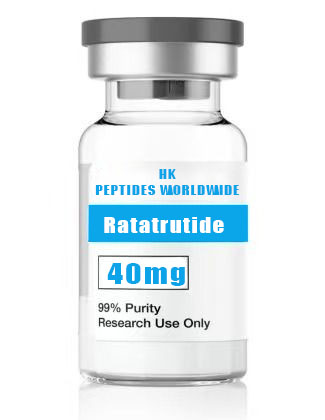
retatrutide 40 mg
Technical Specifications
| Parameter | Value |
|---|---|
| Product Name | Retatrutide (LY3437943) |
| CAS Number | 2381089-83-2 |
| Molecular Formula | C₂₂₃H₃₄₃N₅₅O₆₈ |
| Molecular Weight | ~4845.5 Da |
| Dosage | 40 mg per vial |
| Purity | ≥98% (HPLC-verified) |
| Appearance | White to off-white lyophilized powder |
| Solubility | Soluble in aqueous buffer solutions |
| Storage | -20°C, protected from light and moisture |
| Pharmacological Class | Triple GIP/GLP-1/GCGR receptor agonist |
| Supplier | HK Peptides Worldwide |
| Intended Use | Laboratory and scientific research only |
Product Overview
Retatrutide 40 mg is a research-grade synthetic peptide supplied exclusively for laboratory and scientific investigation. This product occupies the seventh position in HK Peptides Worldwide’s eight-dosage Retatrutide portfolio and represents the upper tier of the expanded-capacity range. With eight times the research material of the 5 mg entry-level format, the 40 mg vial is engineered for sustained, high-consumption research programs, extended multi-phase experimental protocols, core facility distribution, and collaborative multi-institutional research initiatives requiring a single, comprehensively characterized batch of peptide material.
Retatrutide (developmental designation LY3437943) is a rationally designed unimolecular peptide that functions as a balanced triple agonist at the glucose-dependent insulinotropic polypeptide (GIP) receptor, the glucagon-like peptide-1 (GLP-1) receptor, and the glucagon (GCGR) receptor. The peptide’s pharmacological architecture—a 39-amino acid backbone conjugated with a C20 fatty diacid moiety through a gamma-glutamic acid linker—delivers a molecular weight of approximately 4845.5 Daltons and enables simultaneous engagement of three class B G protein-coupled receptors that play central roles in metabolic regulation. This triple agonist mechanism distinguishes Retatrutide as the most advanced commercially available peptide for multi-receptor metabolic pharmacology research.
The 40 mg format is designed for research organizations with established, high-throughput triple agonist capabilities requiring large quantities for sustained investigation. At this dosage level, institutions can execute comprehensive, multi-year research programs; support multiple simultaneous investigator-led projects; conduct extensive high-throughput screening campaigns; develop and validate analytical methods requiring large quantities of reference material; and maintain peptide repositories for distribution to affiliated laboratories. The 40 mg vial ensures research continuity by providing a single, well-characterized batch sufficient for extended experimental timelines, eliminating the variability associated with switching between multiple smaller batches.
Manufactured under controlled conditions using solid-phase peptide synthesis methodology and purified by preparative HPLC, each batch of Retatrutide 40 mg undergoes comprehensive analytical characterization to verify ≥98% purity by analytical HPLC and confirm molecular identity by high-resolution mass spectrometry. HK Peptides Worldwide distributes this product exclusively for in-vitro research applications to qualified research institutions and laboratories. This product is categorically not intended for human consumption, veterinary application, clinical treatment, or diagnostic use.
Molecular Mechanism and Research Background
Advanced Topics in Triple Agonist Pharmacology
At the 40 mg research scale, investigators typically engage with sophisticated pharmacological questions that build upon foundational characterization work. The following advanced research themes are appropriate for investigation at this scale:
Receptor Occupancy and Residence Time: The relationship between ligand concentration, receptor occupancy, and duration of effect is determined not only by binding affinity (Kd) but also by the dissociation rate constant (koff) and consequent receptor residence time. Retatrutide’s lipidated structure, designed for albumin binding, may influence its effective residence time at target receptors in ways that can be investigated using the extended material quantities provided by the 40 mg format. Such studies employ techniques including radioligand kinetic binding assays and BRET-based receptor-ligand interaction monitoring.
Biased Agonism and Functional Selectivity: Beyond simple measures of agonist potency and efficacy, contemporary GPCR pharmacology recognizes that ligands can stabilize distinct receptor conformations that preferentially activate specific intracellular signaling pathways—a phenomenon termed biased agonism or functional selectivity. Retatrutide may exhibit different bias profiles at each of its three target receptors, and the 40 mg format supports systematic characterization of G protein-dependent versus β-arrestin-dependent signaling across GIPR, GLP-1R, and GCGR using complementary assay platforms.
Allosteric Modulation and Cooperativity: The question of whether Retatrutide binding at one receptor population influences the behavior of co-expressed receptor populations—through receptor heterodimerization, downstream signaling cross-talk, or other cooperative mechanisms—is an area of active research interest. The 40 mg quantity supports investigation of these phenomena using techniques such as FRET and BRET for receptor proximity assessment, and functional assays designed to detect cooperative binding or signaling effects.
Tissue-Specific Signaling Profiles: Different cell types express different complements of signaling proteins, regulatory proteins (GRKs, β-arrestins), and receptor-modifying proteins (RAMP proteins), resulting in cell-type-specific responses to the same agonist. The 40 mg format supports profiling of Retatrutide’s signaling across panels of cell lines representing diverse tissue types, enabling characterization of tissue-specific pharmacology.
Research Characteristics
High-Purity Material for Demanding Applications
Retatrutide 40 mg is verified to meet the most stringent purity specifications in the product line, with ≥98% purity by RP-HPLC at 214 nm. The analytical method employs a high-resolution C18 column with optimized gradient conditions that achieve baseline resolution of Retatrutide from closely related impurities. High-resolution mass spectrometry provides mass accuracy within 5 ppm, and the isotopic distribution is confirmed to match the theoretical pattern for the molecular formula. Peptide content is determined by quantitative amino acid analysis to enable accurate solution preparation.
Scaled Manufacturing Excellence
The 40 mg format benefits from manufacturing processes optimized for larger production scales. Solid-phase peptide synthesis is performed using Fmoc chemistry with carefully controlled coupling efficiencies monitored by qualitative tests at each cycle. Preparative HPLC purification employs optimized loading and gradient conditions developed during process characterization. The lyophilization cycle is engineered to produce a powder with low residual moisture and favorable handling characteristics. Each batch is fully documented with traceable raw materials, in-process controls, and final release testing.
Packaging for Extended Storage and Distribution
Each 40 mg vial is fabricated from USP Type I borosilicate glass tubing with appropriate capacity to accommodate the powder volume. The vial is sealed under nitrogen headspace with a bromobutyl rubber stopper and aluminum crimp seal with flip-off cap. This packaging configuration provides long-term protection against moisture, oxygen, and light, supporting extended storage at -20°C. For core facility applications, the packaging is compatible with aseptic aliquoting into smaller containers for distribution.
Research Applications
Core Facility and Repository Operations
The 40 mg format is optimized for institutional core facilities, shared research resources, and peptide repositories that serve multiple investigator groups. A single batch of 40 mg can be aliquoted into research-use quantities (e.g., 5 mg, 10 mg) and distributed to collaborating laboratories, ensuring that all groups work with identical, comprehensively characterized peptide material. This approach enhances cross-study comparability, facilitates multi-site reproducibility assessments, and simplifies quality documentation.
High-Throughput Screening at Scale
The 40 mg quantity supports high-throughput screening campaigns of significant scope:
- Full concentration-response profiling across hundreds of receptor mutants or variants
- Screening against comprehensive GPCR panels for selectivity assessment
- Combination screening with extensive compound libraries for interaction studies
- CRISPR-based functional genomics screens examining modifiers of Retatrutide response
Analytical Method Development and Validation
Laboratories developing validated analytical methods for Retatrutide detection and quantification require substantial quantities of characterized reference material. The 40 mg format supports:
- Full ICH-compliant method validation (linearity, accuracy, precision, specificity, LOD/LOQ, robustness)
- Forced degradation studies for stability-indicating method development
- System suitability test development and qualification
- Cross-validation across multiple analytical platforms (HPLC-UV, LC-MS, LC-MS/MS)
Multi-Year Research Program Support
For research groups with multi-year funding cycles, the 40 mg format provides a single batch sufficient for an entire grant period. This approach:
- Eliminates lot-to-lot variability across years of experimentation
- Simplifies quality documentation and regulatory compliance
- Provides cost efficiency through bulk purchasing
- Ensures uninterrupted research continuity
Institutional Peptide Characterization Programs
The 40 mg quantity supports comprehensive institutional programs for peptide characterization including:
- Advanced structural characterization (circular dichroism, NMR, X-ray crystallography)
- Biophysical characterization (analytical ultracentrifugation, dynamic light scattering)
- Stability profiling under diverse conditions (pH, temperature, light, oxidation)
- Formulation development and excipient compatibility studies
Comparative Dosage Analysis
The High-Capacity Tier: 40 mg in Context
The 40 mg format is positioned in the high-capacity tier of the Retatrutide portfolio, alongside 30 mg, 50 mg, and 60 mg. Understanding the distinctions within this tier is essential for optimal format selection:
| Parameter | 30 mg | 40 mg | 50 mg | 60 mg |
|---|---|---|---|---|
| Relative Capacity | 6× baseline | 8× baseline | 10× baseline | 12× baseline |
| Multi-User Capability | 2-3 groups | 3-4 groups | 4-5 groups | 5-6 groups |
| HTS Scale | Moderate | Substantial | Large | Maximum |
| Core Facility Fit | Entry | Optimal | Expanded | Maximum |
| Cost per mg | Good | Very Good | Excellent | Best |
Why 40 mg Is Optimal for Core Facilities:
The 40 mg format strikes an optimal balance for institutional core facilities: sufficient quantity to serve multiple investigator groups, economical per-milligram cost, and manageable inventory size that does not risk expiration before full utilization. The 8× baseline capacity maps well to distribution in standard research-use aliquots (e.g., eight 5 mg aliquots, four 10 mg aliquots, or combinations thereof).
Selection Guidance for High-Capacity Tier
| Institutional Context | Recommended Format | Rationale |
|---|---|---|
| Single PI, multi-study | 30 mg | Adequate for individual program |
| Core facility, 3-4 users | 40 mg | Optimal distribution and cost |
| Large core, 5+ users | 50 mg | Expanded distribution capacity |
| Industrial screening | 60 mg | Maximum throughput |
Advantages and Limitations
Advantages
- Core Facility Optimization: 40 mg provides optimal balance of distribution capacity and cost efficiency for shared research resources.
- Eight-Fold Baseline Capacity: Eight times the material of the 5 mg format for extensive research programs.
- Unique Triple Agonist Tool: Only commercially available GIP/GLP-1/GCGR triple agonist for research.
- ≥98% Purity: Verified purity supporting publication-quality data.
- Multi-Year Research Support: Single batch sufficient for extended funding cycles.
- HTS Compatibility: Quantity supports large-scale screening campaigns.
- Analytical Method Validation: Adequate material for full ICH-compliant method validation.
- Lot Consistency: All research within a program conducted with identical peptide material.
Limitations
- Research Use Only: Restricted to laboratory investigation; not for therapeutic application.
- In-Vitro Research Focus: Supplied and validated for in-vitro use exclusively.
- Reconstitution Required: Lyophilized format requires aseptic reconstitution.
- Storage Requirements: -20°C storage essential; degradation possible under improper conditions.
- Not a Certified Standard: High purity but not a pharmacopeial reference material.
- Regulatory Compliance: Institutional responsibility for all regulatory aspects of use.
Quality Assurance, Storage, and Compliance
Retatrutide 40 mg undergoes comprehensive release testing (HPLC purity ≥98%, ESI-MS identity, peptide content, residual TFA, residual solvents, endotoxin ≤1.0 EU/mg, bioburden ≤100 CFU/g). Store at -20°C protected from light and moisture. Reconstituted solutions should be aliquoted and stored at -20°C or -80°C. This is a Research Use Only product, not FDA-approved, and carries no therapeutic claims. Researchers assume responsibility for institutional and regulatory compliance.
Frequently Asked Questions (FAQ)
1. What is Retatrutide’s CAS number? CAS 2381089-83-2.
2. Why choose 40 mg over 30 mg or 50 mg? 40 mg is optimal for core facilities serving 3-4 investigator groups, offering excellent per-mg value with manageable inventory size.
3. How many aliquots can I prepare from 40 mg? Eight 5 mg aliquots, four 10 mg aliquots, or combinations thereof.
4. What receptors does Retatrutide target? GIP, GLP-1, and glucagon receptors—balanced triple agonism.
5. What purity is guaranteed? ≥98% by HPLC.
6. Is 40 mg suitable for method validation? Yes, sufficient for full ICH-compliant analytical method validation including forced degradation studies.
7. How should I store Retatrutide 40 mg? -20°C; reconstituted aliquots at -20°C or -80°C.
8. Can this product be used for core facility distribution? Yes, it is specifically optimized for this purpose.
9. Is Retatrutide approved for human use? No. Exclusively for laboratory and scientific research.
10. How do I order for my institution? Contact HK Peptides Worldwide through hkpeptides.net.
Related Research & Resources
| Resource | Description |
|---|---|
| Glp 1 Metabolic Peptides Hub | Complete research overview & methodology hub |
| Retatrutide 10 Mg Scientific Research Ma | Related research peptide product |
| Retatrutide 15 Mg Laboratory Peptide Sup | Related research peptide product |
| Glp 1 Peptides Metabolic Research | Latest research insights & methodology |
View Complete Research Guide »
Disclaimer: Retatrutide 40 mg is a research chemical for laboratory investigation only. No therapeutic claims are made or implied.