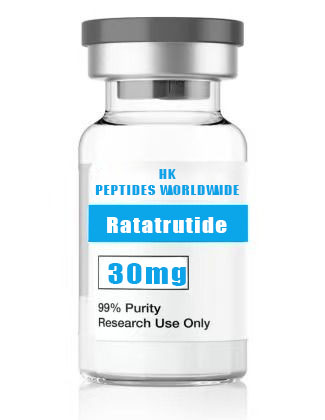
retatrutide 30 mg
Technical Specifications
| Parameter | Value |
|---|---|
| Product Name | Retatrutide (LY3437943) |
| CAS Number | 2381089-83-2 |
| Molecular Formula | C₂₂₃H₃₄₃N₅₅O₆₈ |
| Molecular Weight | ~4845.5 Da |
| Dosage | 30 mg per vial |
| Purity | ≥98% (HPLC-verified) |
| Appearance | White to off-white lyophilized powder |
| Solubility | Soluble in aqueous buffer solutions |
| Storage | -20°C, protected from light and moisture |
| Pharmacological Class | Triple GIP/GLP-1/GCGR receptor agonist |
| Supplier | HK Peptides Worldwide |
| Intended Use | Laboratory and scientific research only |
Product Overview
Retatrutide 30 mg is a research-grade synthetic peptide provided exclusively for controlled laboratory and scientific investigation. This product represents the sixth tier within HK Peptides Worldwide’s comprehensive eight-dosage Retatrutide portfolio and marks the entry into the expanded-capacity range of the product line. With six times the research material of the 5 mg entry-level format, the 30 mg vial is engineered to support multi-study research programs, extended longitudinal experimental designs, high-throughput screening campaigns, and multi-investigator collaborative research initiatives—all from a single, quality-controlled batch.
Retatrutide (LY3437943) is an innovative unimolecular triple agonist peptide simultaneously targeting the glucose-dependent insulinotropic polypeptide (GIP) receptor, glucagon-like peptide-1 (GLP-1) receptor, and glucagon (GCGR) receptor. The peptide features a 39-amino acid backbone derived from the native GIP sequence scaffold, with strategic amino acid substitutions that introduce GLP-1 and GCGR activity while preserving GIP receptor engagement. A C20 fatty diacid moiety (eicosanedioic acid) is conjugated via a hydrophilic gamma-glutamic acid linker, enabling reversible albumin binding that extends the peptide’s research-relevant half-life in experimental models. The molecular weight of approximately 4845.5 Daltons reflects the combined mass of the peptide backbone and the lipidated side chain.
The 30 mg format is designed for research groups with established triple agonist experimental capabilities that require larger quantities for sustained, protocol-driven investigation. At this dosage level, laboratories can execute comprehensive experimental programs encompassing full receptor pharmacological characterization, detailed signaling pathway analysis, extensive comparative pharmacology against reference compounds, stability and formulation development studies, and method qualification and validation activities—all from a single, traceable batch with material remaining for confirmatory replication and exploratory follow-up experiments.
Manufactured under controlled conditions using solid-phase peptide synthesis (Fmoc chemistry) and purified by preparative HPLC, each batch of Retatrutide 30 mg is verified to meet purity specifications of ≥98% by analytical HPLC and confirmed for molecular identity by high-resolution mass spectrometry. HK Peptides Worldwide distributes this product exclusively for in-vitro research applications to qualified research institutions and laboratories in the United States and internationally. This product is not intended for human consumption, veterinary use, clinical treatment, or diagnostic procedures.
Molecular Mechanism and Research Background
Triple Receptor Integration: A Systems Pharmacology Perspective
Retatrutide’s triple agonist mechanism can be understood through the lens of systems pharmacology—the integrated response of interconnected metabolic signaling networks to simultaneous activation of three distinct receptor systems. This framework is essential for designing and interpreting experiments at the 30 mg research scale.
Coordinate Regulation of Glucose Homeostasis: The three receptors targeted by Retatrutide participate in an integrated physiological network for glucose regulation. GIP and GLP-1, secreted from intestinal enteroendocrine cells in response to nutrient ingestion, act as incretin hormones that amplify glucose-stimulated insulin secretion from pancreatic beta-cells. Glucagon, secreted from pancreatic alpha-cells during fasting or hypoglycemia, counter-regulates by promoting hepatic glucose output. Retatrutide’s balanced triple agonism engages this entire regulatory axis simultaneously, providing a research tool for investigating how coordinate modulation of all three receptor systems affects net glucose homeostasis.
Lipid Metabolism Integration: Each receptor component of Retatrutide influences lipid metabolism through distinct but potentially synergistic mechanisms:
- GIPR: Promotes postprandial lipid storage in adipose tissue by enhancing lipoprotein lipase activity and fatty acid uptake.
- GLP-1R: Indirectly influences lipid metabolism through reductions in food intake and delayed gastric emptying, decreasing the rate of nutrient absorption.
- GCGR: Directly stimulates lipolysis in adipose tissue and fatty acid oxidation in the liver, promoting lipid mobilization and utilization.
The net effect of these combined activities in research models is a shift toward enhanced lipid oxidation and reduced lipid storage—a metabolic profile of significant research interest.
Energy Expenditure and Thermogenesis: The glucagon receptor component introduces effects on energy expenditure that are not present with single or dual incretin agonists. GCGR activation in brown adipose tissue increases uncoupling protein 1 (UCP1) activity, dissipating the mitochondrial proton gradient as heat rather than ATP synthesis. This thermogenic effect, combined with GIP/GLP-1-mediated reductions in energy intake, creates an experimental paradigm for investigating the combined effects of increased energy expenditure and reduced energy intake on overall energy balance.
Structural Basis of Balanced Agonism
Retatrutide’s sequence design achieves balanced triple agonism through careful optimization of amino acid residues at key positions:
- N-Terminal Region (Positions 1-7): Critical for receptor activation. The identity of residues at positions 1 (His), 2 (Aib or similar), and 3 (Gln or similar) determines the balance of activity across GIPR, GLP-1R, and GCGR.
- Central Alpha-Helical Domain (Positions 8-21): Contributes to receptor binding affinity and selectivity. Helix-stabilizing residues such as alpha-aminoisobutyric acid (Aib) at strategic positions enhance receptor interactions and protect against proteolytic degradation.
- C-Terminal Region (Positions 22-39): Provides the attachment site for the fatty acid moiety and contributes to overall peptide stability.
Research Characteristics
High-Purity Expanded-Capacity Research Material
Retatrutide 30 mg is verified against a purity specification of ≥98% by RP-HPLC, with the analytical method employing a C18 column and water/acetonitrile gradient optimized for baseline resolution of the Retatrutide peak from impurity peaks. High-resolution accurate-mass mass spectrometry confirms molecular identity on every batch, with mass accuracy within 5 ppm. Peptide content is determined by quantitative amino acid analysis or elemental nitrogen analysis, enabling accurate concentration determination for experimental solutions.
Manufacturing at Scale
The 30 mg format represents a production scale that benefits from optimized manufacturing processes with well-characterized critical process parameters. Solid-phase peptide synthesis is performed under controlled conditions with Fmoc-protected amino acid derivatives. Preparative HPLC purification employs optimized loading, gradient, and fraction collection parameters established during process development. The lyophilization cycle is engineered to produce a uniform, low-moisture powder with favorable reconstitution characteristics.
Protective Packaging for Extended Storage
The 30 mg lyophilized powder is packaged in USP Type I borosilicate glass vials of appropriate capacity to accommodate the larger powder volume. The bromobutyl rubber stopper and aluminum crimp seal provide effective moisture and oxygen barriers, while the nitrogen headspace minimizes oxidative degradation during storage. Vials are shipped in temperature-controlled packaging validated to maintain appropriate temperature ranges during transit.
Research Applications
High-Throughput Screening Campaigns
The 30 mg quantity supports high-throughput screening (HTS) applications where large numbers of assay wells are required:
- Screening of Retatrutide against panels of receptor mutants to identify residues critical for agonist activity
- Profiling across broad panels of GPCRs to assess receptor selectivity
- Testing in diverse cell lines representing different tissue types to characterize cell-type-specific responses
- Combination screening with other pharmacological agents to identify synergistic or antagonistic interactions
Extended Longitudinal Studies
The 30 mg format enables experimental designs extending over weeks or months, including:
- Chronic exposure studies examining effects of sustained receptor activation on cellular phenotype
- Receptor regulation studies tracking desensitization, downregulation, and recovery kinetics
- Differentiation protocols where Retatrutide is present throughout multi-day differentiation timecourses
- Stability studies monitoring peptide integrity under various storage and handling conditions over extended periods
Comprehensive Comparative Pharmacology
The expanded quantity enables thorough comparative pharmacological characterization against a broad panel of reference compounds:
- Multiple GLP-1 receptor agonists (semaglutide, liraglutide, dulaglutide, exenatide)
- Dual GIP/GLP-1 agonists (tirzepatide and investigational compounds)
- Native ligands (GIP(1-42), GLP-1(7-36)amide, glucagon)
- Investigational multi-receptor agonists from published literature
Multi-Endpoint, Multi-Replicate Experimental Designs
The 30 mg quantity supports experimental designs incorporating:
- Technical replicates (triplicate or quadruplicate determinations) for statistical rigor
- Biological replicates (independent experiments on different days) for reproducibility assessment
- Multiple assay endpoints (cAMP, β-arrestin, internalization, signaling pathway activation)
- Parallel testing at all three receptors using complementary assay technologies
Core Facility and Shared Resource Applications
For institutional core facilities, shared research resources, or peptide repositories, the 30 mg format provides a single-source batch for distribution to multiple investigator groups. This approach ensures that all researchers within a collaborative network use identical, quality-controlled peptide material, enhancing cross-study comparability and data integration.
Comparative Dosage Analysis
The Expanded-Capacity Threshold: 30 mg in the Portfolio
The 30 mg format represents the threshold where Retatrutide research transitions from individual-investigator scale to multi-user, programmatic scale. The following analysis positions 30 mg within the eight-dosage portfolio:
| Research Scale | Dosages | Investigator Type | Prototype Application |
|---|---|---|---|
| Individual Pilot | 5-10 mg | Single investigator, exploratory | Method development, feasibility |
| Individual Standard | 15-20 mg | Single investigator, established | Protocol-driven research |
| Programmatic | 30-40 mg | Multi-investigator, collaborative | Multi-study programs |
| Institutional | 50-60 mg | Core facility, high-throughput | Large-scale screening |
Strategic Advantages of the 30 mg Format:
- Six-Fold Baseline Capacity: At 30 mg, researchers have six times the material of the 5 mg format, enabling a proportional expansion in experimental scope.
- Programmatic Research Support: A single vial can support an entire research program comprising receptor characterization, signaling analysis, comparative pharmacology, and exploratory studies.
- Multi-User Resource: The quantity is sufficient for distribution among 2-3 collaborating investigators or laboratory groups.
- Longitudinal Study Capability: Adequate material for extended time-course experiments without concern for peptide depletion mid-study.
- HTS Compatibility: Sufficient quantity for screening applications requiring hundreds to thousands of assay wells.
Selection Guidance by Research Objective
| Research Objective | Optimal Format | Justification |
|---|---|---|
| Assay feasibility | 5 mg | Minimal investment |
| Method validation | 10 mg | Adequate for qualification |
| Confirmatory studies | 15 mg | Multi-assay from single batch |
| Standardized protocols | 20 mg | Optimal individual scale |
| Multi-study program | 30 mg | Programmatic research support |
| Core facility distribution | 40-60 mg | Maximum multi-user efficiency |
Advantages and Limitations
Advantages
- Programmatic Research Scale: 30 mg supports complete multi-study research programs from a single batch.
- Six-Fold Baseline Capacity: Six times the material of the 5 mg format for expanded experimental scope.
- Triple Agonist Research Tool: The only commercially available GIP/GLP-1/GCGR triple agonist for research.
- ≥98% HPLC Purity: Verified purity for reliable and reproducible experimental data.
- HTS Compatibility: Sufficient quantity for screening applications requiring large numbers of assay wells.
- Multi-User Capability: Single batch can serve multiple investigators or research groups.
- Longitudinal Study Support: Adequate material for extended time-course experimental protocols.
- Batch Traceability: Complete documentation from synthesis through release testing.
Limitations
- Research Use Only: Restricted to laboratory scientific investigation; not for therapeutic application.
- In-Vitro Research Focus: Supplied and validated for in-vitro use; in-vivo use requires independent validation.
- Reconstitution Required: Lyophilized format requires careful reconstitution.
- Storage Sensitivity: Requires consistent -20°C storage; degradation possible under improper conditions.
- Not a Pharmacopeial Standard: High purity but not certified as an official reference standard.
- Regulatory Responsibility: Users must ensure compliance with all applicable regulations.
Quality Assurance and Analytical Methods
Each batch of Retatrutide 30 mg undergoes release testing including RP-HPLC purity (≥98% at 214 nm), ESI-MS identity (MW 4845.5 ± 1.0 Da), peptide content by AAA, residual TFA by IC (≤1.0%), residual solvents by GC, endotoxin by LAL (≤1.0 EU/mg), and bioburden testing (≤100 CFU/g). A Certificate of Analysis documents all results and is available for each batch.
Storage and Handling Protocols
Store unopened vials at -20°C, protected from light and moisture. Reconstitute using aseptic technique with an appropriate solvent (PBS pH 7.4 or sterile water recommended). Aliquot reconstituted solutions into single-use volumes and store at -20°C or -80°C. Avoid repeated freeze-thaw cycles. Document lot numbers and reconstitution details for traceability.
Regulatory and Compliance Information
Retatrutide 30 mg is classified as a Research Use Only (RUO) product. It is not manufactured under pharmaceutical GMP, not FDA-approved as a drug product, and carries no therapeutic indications or claims. Researchers assume responsibility for institutional and regulatory compliance in all aspects of product acquisition, storage, handling, and experimental use.
Frequently Asked Questions (FAQ)
1. What is the CAS number and molecular weight of Retatrutide? CAS 2381089-83-2, molecular weight ~4845.5 Da.
2. What distinguishes the 30 mg format? 30 mg marks the entry into expanded-capacity research, providing six times the material of the 5 mg format and supporting multi-study programs, HTS campaigns, and collaborative multi-investigator research.
3. How many assay wells can I run with 30 mg? Approximately 300-600 individual assay wells, depending on concentration ranges and assay volumes.
4. What receptors does Retatrutide activate? GIP receptor, GLP-1 receptor, and glucagon receptor—balanced triple agonism.
5. What purity is guaranteed? ≥98% by RP-HPLC.
6. Is Retatrutide 30 mg suitable for high-throughput screening? Yes, the quantity supports HTS applications requiring hundreds to thousands of assay wells.
7. How should I store this product? -20°C for unopened vials; reconstituted aliquots at -20°C or -80°C.
8. Can this product be shared among multiple investigators? Yes, the 30 mg format provides sufficient material for distribution among 2-3 collaborating research groups.
9. Is Retatrutide 30 mg suitable for in-vivo studies? This product is supplied for in-vitro research. In-vivo use requires independent validation and institutional approvals.
10. Can individuals purchase Retatrutide 30 mg for personal use? No. This product is available exclusively to qualified research institutions and laboratories.
Disclaimer: Retatrutide 30 mg is a research chemical for laboratory investigation only. No therapeutic claims are made or implied. All statements regarding pharmacological mechanisms are based on publicly available scientific literature.
Related Research & Resources
| Resource | Description |
|---|---|
| Glp 1 Metabolic Peptides Hub | Complete research overview & methodology hub |
| Retatrutide 10 Mg Scientific Research Ma | Related research peptide product |
| Retatrutide 15 Mg Laboratory Peptide Sup | Related research peptide product |
| Glp 1 Peptides Metabolic Research | Latest research insights & methodology |