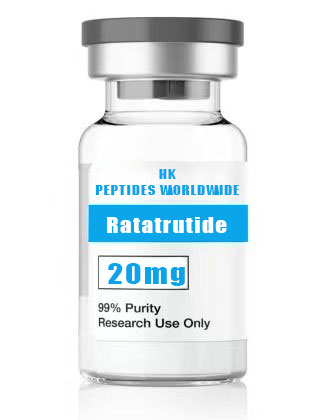
retatrutide 20 mg
Technical Specifications
| Parameter | Value |
|---|---|
| Product Name | Retatrutide (LY3437943) |
| CAS Number | 2381089-83-2 |
| Molecular Formula | C₂₂₃H₃₄₃N₅₅O₆₈ |
| Molecular Weight | ~4845.5 Da |
| Dosage | 20 mg per vial |
| Purity | ≥98% (HPLC-verified) |
| Appearance | White to off-white lyophilized powder |
| Solubility | Soluble in aqueous buffer solutions |
| Storage | -20°C, protected from light and moisture |
| Pharmacological Class | Triple GIP/GLP-1/GCGR receptor agonist |
| Supplier | HK Peptides Worldwide |
| Intended Use | Laboratory and scientific research only |
Product Overview
Retatrutide 20 mg is a research-grade synthetic peptide supplied exclusively for laboratory and scientific investigation. Occupying the midpoint of HK Peptides Worldwide’s eight-dosage Retatrutide portfolio, the 20 mg format represents the threshold where research transitions from exploratory and confirmatory phases into standardized, protocol-driven investigation. With four times the material of the 5 mg entry-level format, the 20 mg vial provides the capacity for comprehensive multi-endpoint experimental programs, sustained longitudinal studies, and multi-investigator collaborative research—all from a single, traceable batch of peptide material.
Retatrutide (developmental designation LY3437943) is an engineered unimolecular triple agonist that simultaneously activates the glucose-dependent insulinotropic polypeptide (GIP) receptor, glucagon-like peptide-1 (GLP-1) receptor, and glucagon (GCGR) receptor. The peptide’s 39-amino acid backbone, conjugated with a C20 fatty diacid moiety through a gamma-glutamic acid linker, yields a molecular weight of approximately 4845.5 Daltons. This structural engineering achieves balanced multi-receptor pharmacology alongside an extended duration of action through reversible albumin binding—characteristics that position Retatrutide as the most advanced commercially available peptide for multi-receptor metabolic research.
The 20 mg format addresses the requirements of established research laboratories conducting protocol-driven investigations. At this dosage level, researchers gain the flexibility to execute complete experimental designs encompassing receptor characterization, signaling pathway analysis, comparative pharmacology, stability assessment, and method validation—all from a single vial with sufficient material remaining for confirmatory replication. This quantity is particularly well-suited for laboratories that have validated their assay systems with smaller formats (5-15 mg) and are now scaling to standardized, publication-quality experimental programs.
HK Peptides Worldwide manufactures Retatrutide 20 mg under controlled conditions using solid-phase peptide synthesis, with each batch verified by HPLC and mass spectrometry to ensure ≥98% purity. This product is distributed exclusively for in-vitro research applications and carries no therapeutic indications or clinical claims whatsoever.
Molecular Mechanism and Research Background
Evolutionary Context of Multi-Receptor Pharmacology
The progression from single-receptor to multi-receptor peptide agonists represents one of the most significant conceptual advances in metabolic research pharmacology. Understanding this evolution provides essential context for Retatrutide research:
Monotherapy Era (Single Receptor): Initial research focused on selective GLP-1 receptor agonists (exenatide, liraglutide, semaglutide), establishing the therapeutic relevance of incretin-based pharmacology. These investigations demonstrated that sustained GLP-1 receptor activation could produce clinically meaningful effects on glycemic control and body weight.
Combination Era (Dual Receptor): The recognition that native postprandial physiology involves coordinated secretion of multiple gut hormones—GIP, GLP-1, PYY, oxyntomodulin—motivated investigation of unimolecular peptides capable of engaging multiple receptors simultaneously. This led to the development of dual GIP/GLP-1 receptor agonists, most notably tirzepatide, which demonstrated enhanced metabolic effects compared to selective GLP-1 agonists.
Integration Era (Triple Receptor): Retatrutide represents the integration of glucagon receptor agonism into the dual agonist framework. The scientific rationale is that GCGR-mediated increases in energy expenditure and lipid oxidation, when balanced against the glucose-lowering actions of GIP and GLP-1 agonism, produce a more comprehensive metabolic effect than dual agonism alone.
GCGR Agonism: The Third Dimension
The glucagon receptor component of Retatrutide requires particular consideration because it introduces pharmacological effects qualitatively distinct from incretin receptor agonism:
- Hepatic Effects: GCGR activation stimulates glycogenolysis, gluconeogenesis, fatty acid oxidation, and ketogenesis in the liver through cAMP/PKA/CREB signaling cascades.
- Adipose Tissue Effects: Glucagon promotes lipolysis in white adipose tissue through hormone-sensitive lipase activation, increasing circulating free fatty acids available for hepatic oxidation.
- Thermogenic Effects: GCGR signaling in brown adipose tissue and potentially in beige/brite adipocytes increases uncoupled respiration and energy expenditure.
- Satiety Effects: Glucagon may contribute to satiety signaling through vagal afferent activation and central nervous system mechanisms.
The balanced activity profile of Retatrutide is designed such that the hyperglycemic potential of GCGR agonism is offset by GIP/GLP-1-mediated insulin secretion and glucose disposal, while the lipolytic and thermogenic effects of glucagon are additive or synergistic with the weight-reducing effects of incretin receptor activation.
Research Characteristics
High-Purity Research Material (≥98%)
Retatrutide 20 mg is verified against a purity specification of ≥98% by RP-HPLC with dual-wavelength detection. The analytical method utilizes a C18 stationary phase with a gradient elution profile optimized for resolution of Retatrutide from structurally related impurities. High-resolution mass spectrometry confirms molecular identity on every batch, with mass accuracy within 5 ppm of the theoretical monoisotopic mass. Peptide content is determined by quantitative amino acid analysis, enabling accurate concentration calculations for experimental solutions.
Manufacturing Quality and Consistency
The 20 mg format benefits from optimized manufacturing processes refined across production scales. Solid-phase peptide synthesis using Fmoc chemistry, followed by preparative HPLC purification under controlled conditions, yields a product with well-characterized impurity profiles and demonstrated batch-to-batch consistency. Each manufacturing campaign is supported by comprehensive batch documentation including raw material traceability, in-process control data, and final release test results.
Packaging and Stability Engineering
Each 20 mg vial is fabricated from USP Type I borosilicate glass and sealed with a bromobutyl rubber stopper under an inert gas headspace (typically nitrogen) to minimize oxidative degradation. The aluminum crimp seal with flip-off cap provides tamper evidence and secures the closure during storage and distribution. Vials are shipped in temperature-controlled packaging with temperature monitoring capabilities.
Research Applications
Standardized Laboratory Research Protocols
The 20 mg format is specifically designed for established laboratory protocols that have been validated with smaller quantities and are now being executed at scale. Applications include:
- Receptor Pharmacology: Complete characterization of agonist potency, efficacy, and binding kinetics at GIPR, GLP-1R, and GCGR using radioligand binding, cAMP, β-arrestin, and receptor internalization endpoints.
- Signaling Network Mapping: Phosphoproteomic and transcriptomic analysis of signaling networks engaged by triple receptor agonism in relevant cell types.
- Receptor Dimerization Studies: Investigation of potential receptor heterodimerization or cross-talk among co-expressed GIP, GLP-1, and glucagon receptors using BRET, FRET, or co-immunoprecipitation approaches.
- Structure-Activity Relationship (SAR) Studies: Comparative analysis of Retatrutide against structural analogs, truncation variants, or peptides with modified activity ratios.
Longitudinal and Kinetic Studies
The 20 mg quantity supports time-course experimental designs examining:
- Receptor desensitization, internalization, and resensitization kinetics
- Sustained versus pulsatile receptor activation effects on downstream signaling
- Chronic exposure effects on receptor expression and cellular responsiveness
- Degradation kinetics under various experimental conditions
Multi-Investigator Collaborative Research
For research groups with multiple investigators or core facilities serving multiple laboratories, the 20 mg format provides a shared resource sufficient for several independent experimental programs. A single vial can support receptor characterization by one investigator, signaling pathway analysis by a second, and comparative pharmacology by a third—all from a single, quality-controlled batch.
Method Transfer and Inter-Laboratory Reproducibility
The 20 mg quantity is adequate for method transfer and reproducibility studies across collaborating laboratories. Identical aliquots from a single vial can be distributed to multiple sites for parallel analysis, enabling assessment of inter-laboratory variability and robustness of experimental protocols.
Comparative Dosage Analysis
The Midpoint Format: 20 mg in Context
As the midpoint of the eight-dosage Retatrutide range, the 20 mg format occupies a strategic position that balances research capacity with cost efficiency. The following analysis contextualizes 20 mg within the product portfolio:
| Dosage Tier | Formats | Research Phase | Key Characteristic |
|---|---|---|---|
| Exploratory | 5 mg, 10 mg | Screening, method development | Minimal viable quantity |
| Transitional | 15 mg | Confirmatory studies | Bridging to standardized protocols |
| Standardized | 20 mg | Protocol-driven research | Optimal balance of capacity and cost |
| Expanded | 30 mg, 40 mg | Multi-study programs | Extended research continuity |
| Production | 50 mg, 60 mg | High-throughput, core facilities | Maximum efficiency |
Unique Value Proposition of 20 mg:
- Balanced Sweet Spot: 20 mg represents the optimal balance between research capacity (sufficient for comprehensive protocols) and cost (economical per-mg pricing without excess material that may expire unused).
- Publication-Quality Research: The quantity supports the experimental rigor required for publication-quality data, including technical replicates, biological replicates, and independent replication of key findings.
- Protocol Standardization Threshold: Laboratories adopting 20 mg as their standard format can develop standardized operating procedures, stock solutions, and data analysis pipelines calibrated to this quantity.
- Peer-Comparable Research Scale: Many published studies in the multi-receptor agonist field utilize peptide quantities in the 15-25 mg range, making 20 mg a peer-comparable research scale.
Selection Matrix
| Research Scenario | Recommended Format | Rationale |
|---|---|---|
| First-time triple agonist exploration | 5 mg | Minimize investment during feasibility |
| Assay validation and replication | 10 mg | Sufficient for method qualification |
| Transition from pilot to production | 15 mg | Bridge between screening and protocols |
| Established standardized protocols | 20 mg | Optimal balance for protocol-driven research |
| Multi-experiment, multi-endpoint studies | 30 mg | Additional capacity for complexity |
| Core facility, shared resource | 40-60 mg | Maximum efficiency for multiple users |
Advantages and Limitations
Advantages
- Standardized Research Scale: 20 mg supports complete, publication-quality experimental programs from a single vial.
- Cost-Efficient Midpoint: Economical per-milligram cost without the commitment of larger formats.
- Triple Agonist Uniqueness: The only commercially available research peptide combining GIP, GLP-1, and GCGR agonism.
- ≥98% Purity: HPLC-verified purity supports reliable pharmacological data.
- Protocol Compatibility: Suitable for diverse in-vitro assay formats and analytical methods.
- Multi-User Capability: Sufficient material for collaborative or multi-investigator research programs.
- Batch Traceability: Complete documentation from synthesis through release testing.
Limitations
- Research Use Only: Restricted to laboratory scientific investigation; not for therapeutic application.
- In-Vitro Research Focus: Supplied and validated for in-vitro use; in-vivo application requires independent validation.
- Reconstitution Required: Lyophilized powder must be reconstituted before use.
- Temperature-Sensitive Storage: Requires -20°C storage; degradation possible under suboptimal conditions.
- Not a Pharmacopeial Standard: While high purity, not certified as an official reference standard.
- Regulatory Compliance: Users bear responsibility for institutional and legal compliance.
Quality Assurance and Analytical Methods
The release testing program for Retatrutide 20 mg includes RP-HPLC purity (≥98%), ESI-MS identity confirmation (MW 4845.5 ± 1.0 Da), peptide content by amino acid analysis, residual TFA by ion chromatography (≤1.0%), residual solvents by GC, endotoxin by LAL (≤1.0 EU/mg), and bioburden by membrane filtration (≤100 CFU/g). Each batch is accompanied by a Certificate of Analysis documenting all results.
Storage and Handling Protocols
Store unopened vials at -20°C, protected from light and moisture. Reconstitute using appropriate aseptic technique with a solvent compatible with downstream applications (typically PBS pH 7.4 or sterile water). Prepare single-use aliquots of reconstituted solutions and store at -20°C or -80°C; avoid repeated freeze-thaw cycles. Short-term storage (≤1 week) at 2-8°C may be acceptable but requires validation under specific experimental conditions.
Regulatory and Compliance Information
Retatrutide 20 mg is a Research Use Only (RUO) product. It is not produced under pharmaceutical GMP, not FDA-approved as a drug, and carries no therapeutic claims. Researchers are responsible for institutional and regulatory compliance.
Frequently Asked Questions (FAQ)
1. What is the CAS number for Retatrutide? CAS 2381089-83-2.
2. What distinguishes the 20 mg format? 20 mg is the midpoint of the eight-dosage Retatrutide range, offering optimal balance between research capacity and cost efficiency for standardized, protocol-driven research programs.
3. How many experiments can I run with a 20 mg vial? Approximately 200-400 individual assay wells, depending on concentration ranges and assay volumes.
4. What receptors does Retatrutide target? GIP receptor, GLP-1 receptor, and glucagon receptor—balanced triple agonism.
5. What purity level is guaranteed? ≥98% by HPLC.
6. How should Retatrutide 20 mg be stored? Unopened vials at -20°C; reconstituted aliquots at -20°C or -80°C.
7. Is Retatrutide 20 mg suitable for multi-user facilities? Yes, the 20 mg quantity supports multiple independent research programs from a single batch.
8. Can Retatrutide be used in radioligand binding assays? Yes, with sufficient quantity for both saturation and competition binding experimental designs.
9. Is this product approved for human use? No. Retatrutide 20 mg is exclusively for laboratory and scientific research.
10. Can I purchase Retatrutide for personal use? No. This product is supplied only to qualified research institutions.
Related Research & Resources
| Resource | Description |
|---|---|
| Glp 1 Metabolic Peptides Hub | Complete research overview & methodology hub |
| Retatrutide 10 Mg Scientific Research Ma | Related research peptide product |
| Retatrutide 15 Mg Laboratory Peptide Sup | Related research peptide product |
| Glp 1 Peptides Metabolic Research | Latest research insights & methodology |
View Complete Research Guide »
Disclaimer: Retatrutide 20 mg is a research chemical for laboratory investigation only. No therapeutic claims are made or implied.