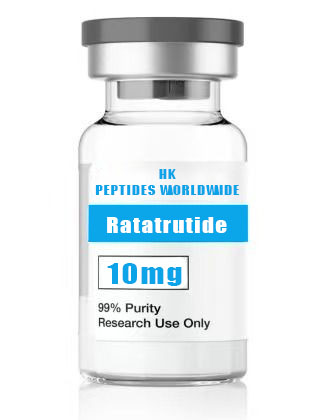
retatrutide 15 mg
Technical Specifications
| Parameter | Value |
|---|---|
| Product Name | Retatrutide (LY3437943) |
| CAS Number | 2381089-83-2 |
| Molecular Formula | C₂₂₃H₃₄₃N₅₅O₆₈ |
| Molecular Weight | ~4845.5 Da |
| Dosage | 15 mg per vial |
| Purity | ≥98% (HPLC-verified) |
| Appearance | White to off-white lyophilized powder |
| Solubility | Soluble in aqueous buffer solutions |
| Storage | -20°C, protected from light and moisture |
| Pharmacological Class | Triple GIP/GLP-1/GCGR receptor agonist |
| Supplier | HK Peptides Worldwide |
| Intended Use | Laboratory and scientific research only |
Product Overview
Retatrutide 15 mg is a research-grade synthetic peptide provided exclusively for controlled laboratory and scientific investigation. Positioned as the third tier in HK Peptides Worldwide’s eight-point Retatrutide dosage range, the 15 mg format represents a meaningful expansion in research capacity—offering three times the material of the 5 mg entry-level format and 50% more than the 10 mg intermediate tier. This quantity is specifically engineered to support confirmatory research studies, multi-assay experimental panels, and methodical investigations requiring multiple independent biological replicates across several experimental endpoints.
Retatrutide, identified by its developmental code LY3437943, is a unimolecular triple agonist peptide that simultaneously activates the glucose-dependent insulinotropic polypeptide (GIP) receptor, the glucagon-like peptide-1 (GLP-1) receptor, and the glucagon (GCGR) receptor. With a molecular weight of approximately 4845.5 Daltons, Retatrutide incorporates a 39-amino acid backbone modified with a C20 fatty diacid side chain conjugated through a gamma-glutamic acid linker. This engineered architecture enables balanced multi-receptor pharmacology alongside extended receptor engagement through reversible albumin binding.
The 15 mg format is the first dosage in the product line that provides sufficient material for a complete confirmatory research program on a single vial. Where 5 mg supports screening and 10 mg enables replication, 15 mg empowers researchers to execute comprehensive experimental protocols encompassing dose-response characterization across all three target receptors, signaling pathway dissection through complementary assay technologies, comparative pharmacology against reference compounds, and preliminary stability and formulation assessment—all from a single batch of peptide.
Manufactured under controlled conditions using solid-phase peptide synthesis and verified through rigorous analytical characterization, each batch of Retatrutide 15 mg delivers ≥98% purity as confirmed by HPLC and mass spectrometry. HK Peptides Worldwide distributes this product exclusively for in-vitro research applications, and it is not intended for human consumption, veterinary use, clinical treatment, or diagnostic procedures.
Molecular Mechanism and Research Background
The Pharmacological Significance of Triple Agonism
Retatrutide’s mechanism of action—balanced agonism at three metabolically significant class B G protein-coupled receptors—represents a research paradigm that has evolved through successive waves of pharmaceutical innovation. Understanding the molecular basis of this triple agonism is essential for designing and interpreting experiments with this research tool.
GIP Receptor Pharmacology: The GIP receptor is a class B GPCR coupled primarily to Gαs, stimulating adenylate cyclase activity and increasing intracellular cAMP levels upon activation. GIP is secreted postprandially from intestinal enteroendocrine K-cells and exerts insulinotropic effects that are strictly glucose-dependent, meaning insulin secretion is potentiated only in the presence of elevated blood glucose. Beyond the pancreas, GIP receptors are expressed in adipocytes, where they regulate lipoprotein lipase activity and fatty acid uptake; in osteoblasts and osteoclasts, where they modulate bone remodeling; and in specific regions of the central nervous system. The GIP component of Retatrutide’s activity profile contributes to its insulinotropic efficacy while potentially improving the gastrointestinal tolerability profile relative to pure GLP-1 agonists.
GLP-1 Receptor Pharmacology: The GLP-1 receptor shares the Gαs coupling mechanism of GIPR but is distinguished by a broader physiological repertoire that includes inhibition of gastric emptying, suppression of glucagon secretion, and activation of satiety circuits in the hypothalamus and brainstem. GLP-1 is produced by proteolytic cleavage of proglucagon in intestinal L-cells and in specific neuronal populations of the nucleus tractus solitarius. The GLP-1 component of Retatrutide’s pharmacology is fundamental to its effects on glycemic parameters and body weight regulation in research models.
Glucagon Receptor Pharmacology: The glucagon receptor, also a class B GPCR coupled to Gαs, is predominantly expressed in the liver, with additional expression in kidney, heart, adipose tissue, and the central nervous system. GCGR activation stimulates glycogenolysis and gluconeogenesis through cAMP/PKA-dependent phosphorylation cascades, increases hepatic fatty acid oxidation, and promotes ketogenesis. The metabolic rationale for including GCGR activity in Retatrutide centers on glucagon’s ability to increase energy expenditure and promote lipid catabolism—effects that, when balanced against the glucose-lowering actions of GIP and GLP-1 receptor agonism, produce a net metabolic benefit in experimental models.
The Activity Ratio Hypothesis
A central concept in Retatrutide research is the “activity ratio”—the relative potency and efficacy of the peptide at each of its three target receptors. Retatrutide has been engineered to achieve a specific balance: sufficient GIP and GLP-1 activity to provide insulinotropic and satiety effects, combined with calibrated GCGR activity that enhances energy expenditure without causing unacceptable hyperglycemia. This balanced agonism distinguishes Retatrutide from investigational molecules that exhibit imbalanced multi-receptor activity profiles, where excessive GCGR activity might overwhelm the counter-regulatory capacity of concurrent incretin receptor activation.
Research Characteristics
High-Purity Triple Agonist Research Material
Retatrutide 15 mg is verified to meet a purity specification of ≥98% by RP-HPLC with detection at 214 nm (peptide bond absorbance) and 280 nm (aromatic residue absorbance). The analytical method employs a C18 reversed-phase column with a water/acetonitrile gradient containing 0.1% TFA as ion-pairing agent, optimized to resolve Retatrutide from closely related peptide impurities including deletion sequences, truncation products, and oxidation variants. High-resolution mass spectrometry confirms molecular identity, with the observed deconvoluted mass required to fall within 4845.5 ± 1.0 Da.
Quality Manufacturing Framework
Solid-phase peptide synthesis of Retatrutide 15 mg is performed using Fmoc chemistry on an appropriate solid support resin. Following cleavage and global deprotection, the crude peptide is purified by preparative RP-HPLC, and fractions meeting purity specifications are pooled and lyophilized. The lyophilization cycle is optimized to produce a uniform, easily reconstituted powder with low residual moisture content. Each manufacturing batch is assigned a unique lot number, and comprehensive batch records document all production steps, in-process controls, and release test results.
Protective Packaging Engineering
Each 15 mg vial is fabricated from USP Type I borosilicate glass tubing, selected for its low extractable profile and compatibility with peptide lyophilizates. The closure system consists of a bromobutyl rubber stopper (compliant with USP <381> for elastomeric closures) secured by an aluminum crimp seal with a flip-off plastic cap. This configuration provides effective protection against environmental moisture, atmospheric oxygen, and microbial ingress during storage and distribution.
Research Applications
Comprehensive Dose-Response Characterization
The 15 mg format provides sufficient material for complete concentration-response curve generation across all three target receptors using multiple complementary assay technologies. Researchers can perform parallel determinations of agonist potency (EC₅₀) and efficacy (E_max) using cAMP accumulation, β-arrestin recruitment, and receptor internalization endpoints. The additional material relative to 5 mg and 10 mg formats supports 10-12 point concentration-response curves with triplicate determinations, enabling accurate nonlinear regression analysis and reliable potency estimates.
Signaling Pathway Dissection
Retatrutide 15 mg enables systematic investigation of the intracellular signaling networks engaged by triple receptor agonism. Experimental approaches may include:
- Selective pharmacological inhibition of specific signaling pathway components (PKA inhibitors, β-arrestin-biased tools)
- Quantitative measurement of second messenger production (cAMP, IP₃, Ca²⁺)
- Phosphoproteomic analysis of downstream kinase activation cascades
- Transcriptional profiling of gene expression changes following sustained receptor engagement
Multi-Endpoint Comparative Pharmacology
The 15 mg quantity supports head-to-head comparative studies examining Retatrutide alongside:
- Selective GLP-1 receptor agonists (semaglutide, liraglutide, exenatide)
- Dual GIP/GLP-1 receptor agonists (tirzepatide)
- Native peptide hormones (GIP, GLP-1(7-36)amide, glucagon)
- Investigational multi-receptor agonists from published literature
Such comparative data are essential for understanding the pharmacological consequences of combining three receptor activities in a single molecule and for identifying structure-activity relationships that may guide future peptide engineering efforts.
Receptor Desensitization and Trafficking Studies
Sustained receptor activation can lead to regulatory processes including receptor phosphorylation, β-arrestin recruitment, internalization, and intracellular trafficking. Retatrutide 15 mg provides sufficient material for time-course studies examining the kinetics of these regulatory events at GIP, GLP-1, and GCGR receptors, as well as investigations into potential cross-regulation among co-expressed receptor populations.
Method Qualification and Robustness Testing
For laboratories developing standardized analytical methods for Retatrutide detection and quantification (HPLC, LC-MS/MS, ELISA), the 15 mg format provides adequate material for method qualification activities including linearity assessment, precision determination (repeatability and intermediate precision), accuracy evaluation, and robustness testing under varied chromatographic conditions.
Comparative Dosage Analysis
15 mg in the Research Workflow
The 15 mg format represents a strategic dosage that bridges the gap between exploratory research (5-10 mg) and established, high-throughput protocols (30-60 mg). The following analysis positions 15 mg within the broader Retatrutide product portfolio:
| Dosage | Relative Capacity | Primary Research Application |
|---|---|---|
| 5 mg | Baseline (1×) | Screening, method development |
| 10 mg | 2× baseline | Replication, dose-response |
| 15 mg | 3× baseline | Confirmatory studies, multi-assay panels |
| 20 mg | 4× baseline | Standardized laboratory protocols |
| 30 mg | 6× baseline | Multi-user, extended studies |
| 40 mg | 8× baseline | High-consumption protocols |
| 50 mg | 10× baseline | Core facility, large-scale screening |
| 60 mg | 12× baseline | Industrial-scale research programs |
Distinctive Features of the 15 mg Format:
- Confirmatory Research Capability: 15 mg is the first dosage that supports a complete, self-contained confirmatory research study from a single vial—encompassing receptor characterization, signaling pathway analysis, and comparative pharmacology.
- Three Receptor Coverage: With 15 mg, researchers can allocate approximately 5 mg of effective material per target receptor for in-depth characterization, enabling balanced investigation across GIPR, GLP-1R, and GCGR.
- Statistical Rigor: The increased quantity supports the triplicate or quadruplicate determinations necessary for robust statistical analysis, moving beyond the duplicate determinations typical of pilot-scale work.
- Transition Point: This format marks the threshold where research transitions from “can we measure this effect?” to “how precisely and reproducibly can we characterize this pharmacology?”
Selection Guidance
Optimal for 15 mg:
- Confirmatory studies requiring full concentration-response characterization across all three receptors
- Signaling bias and pathway selectivity investigations requiring multiple assay endpoints
- Graduate research projects with defined, multi-experiment experimental aims
- Method qualification and validation activities for analytical procedures
- Comparative studies with 2-3 reference comparator compounds
Consider 5-10 mg when:
- Conducting initial receptor screening or assay feasibility assessment
- Performing single-endpoint experiments with limited replicates
- Evaluating whether triple agonist research aligns with laboratory capabilities
Consider 20-30 mg when:
- Experimental designs require independent biological replicates in addition to technical replicates
- Research programs involve multiple investigators or collaborative groups
- Protocols consume higher peptide quantities per assay (e.g., radioligand binding saturation experiments)
Advantages and Limitations
Advantages
- Confirmatory Study Capability: 15 mg supports a complete research program from a single, traceable batch of peptide material.
- Three-Receptor Balance: Sufficient material for in-depth characterization at each of Retatrutide’s target receptors.
- Triple Agonist Tool Compound: The only commercially available research-grade peptide combining GIP, GLP-1, and GCGR receptor agonism.
- ≥98% HPLC Purity: Verified purity essential for reliable pharmacological characterization.
- Batch Consistency: Standardized manufacturing ensures reproducibility across experiments and studies.
- Statistical Rigor Support: Enables triplicate/quadruplicate determinations for robust data analysis.
- Cost-Effective Scaling: Economical per-milligram cost relative to smaller formats.
Limitations
- Research Use Only: Not for human or veterinary therapeutic application. Restricted to laboratory scientific investigation.
- In-Vitro Validation: Supplied and characterized for in-vitro research; in-vivo use requires independent validation.
- Reconstitution Requirement: Lyophilized format requires careful reconstitution technique.
- Temperature-Sensitive Storage: Requires -20°C storage; degradation possible under inappropriate conditions.
- Not a Certified Reference Standard: While manufactured to high purity, this is not a pharmacopeial reference material.
- Regulatory Responsibility: Users must ensure institutional and legal compliance in all research activities.
Quality Assurance and Analytical Methods
Release Testing Protocol
Every batch of Retatrutide 15 mg undergoes a standardized release testing protocol:
- Appearance: Visual examination confirms a white to off-white lyophilized powder free from visible particulates or discoloration.
- Purity (RP-HPLC): ≥98.0% by area normalization at 214 nm, with individual impurity peaks characterized when exceeding 0.5%.
- Identity (ESI-MS): High-resolution mass spectrometry confirms molecular weight within 4845.5 ± 1.0 Da, with isotopic distribution pattern consistent with the molecular formula.
- Peptide Content: Amino acid analysis or nitrogen determination quantifies net peptide content, correcting for water, counterions, and residual solvents.
- Residual TFA: Ion chromatography confirms TFA content ≤1.0%, consistent with TFA salt form from HPLC purification.
- Residual Solvents: GC headspace analysis per ICH Q3C guidelines.
- Endotoxin: LAL kinetic chromogenic method, acceptance criterion ≤1.0 EU/mg.
- Bioburden: Total aerobic microbial count ≤100 CFU/g.
Certificate of Analysis Documentation
Each batch is accompanied by a Certificate of Analysis (CoA) documenting the results of all release tests. The CoA includes lot number, manufacturing date, retest date, analytical methods employed, acceptance criteria, and actual results. Researchers are encouraged to review the CoA before initiating experiments and to retain CoA documentation in laboratory records for traceability purposes.
Storage and Handling Protocols
Recommended Storage
- Unopened Vials: -20°C ± 5°C, protected from light and moisture. Under these conditions, the lyophilized peptide is expected to remain within specifications for 24 months from the date of manufacture.
- Reconstituted Solutions: Aliquot into single-use volumes and store at -20°C or -80°C. Avoid repeated freeze-thaw cycles. Short-term storage (≤1 week) at 2-8°C may be acceptable but should be validated for the specific experimental application.
Reconstitution Protocol
- Equilibrate the sealed vial to room temperature (15-30 minutes).
- Using aseptic technique, add the calculated volume of appropriate solvent (PBS pH 7.4, sterile water, or buffer compatible with downstream assays).
- Gently swirl to dissolve; avoid vortexing or vigorous shaking.
- Inspect for complete dissolution; the solution should be clear and colorless to faintly yellow.
- Calculate final concentration using net peptide content from the CoA.
- Prepare single-use aliquots if the entire volume will not be consumed immediately.
Regulatory and Compliance Information
Retatrutide 15 mg is supplied as a Research Use Only (RUO) product for laboratory and scientific investigation. It is not manufactured under pharmaceutical GMP, has not been evaluated by the FDA or other regulatory authorities as a drug product, and carries no therapeutic indications or claims. Purchasers assume responsibility for institutional and regulatory compliance, including adherence to laboratory safety standards and relevant import/export regulations.
Frequently Asked Questions (FAQ)
1. What is Retatrutide’s CAS number? CAS 2381089-83-2.
2. What makes 15 mg different from 5 mg and 10 mg? The 15 mg format provides three times the material of the 5 mg vial, enabling complete confirmatory studies including multi-receptor characterization, signaling pathway analysis, and comparative pharmacology from a single batch.
3. How many experiments can I run with 15 mg? Depending on assay format and concentration ranges, approximately 150-300 individual assay wells (at typical concentrations of 1 nM–10 µM in 100 µL assay volumes).
4. What receptors does Retatrutide target? GIP receptor, GLP-1 receptor, and glucagon receptor—balanced triple agonism.
5. What purity level is guaranteed? ≥98% by HPLC at 214 nm.
6. Can Retatrutide be used in cell-based assays? Yes, with appropriate aseptic reconstitution technique. Verify endotoxin levels are compatible with your cell system.
7. How should I store this product? -20°C for unopened vials; aliquoted solutions at -20°C or -80°C.
8. Is Retatrutide suitable for in-vivo research? This product is supplied for in-vitro research. In-vivo use requires independent validation and institutional animal research approvals.
9. How does Retatrutide compare to tirzepatide? Retatrutide adds glucagon receptor agonism to the GIP/GLP-1 dual agonism of tirzepatide, enabling investigation of GCGR-mediated metabolic effects.
10. Is this product available for personal use? No. Retatrutide 15 mg is supplied exclusively to qualified research institutions and laboratories.
Disclaimer: This document is for informational purposes only. Retatrutide 15 mg is a research chemical intended exclusively for laboratory and scientific investigation. No therapeutic claims are made or implied.
Related Research & Resources
| Resource | Description |
|---|---|
| Glp 1 Metabolic Peptides Hub | Complete research overview & methodology hub |
| Retatrutide 10 Mg Scientific Research Ma | Related research peptide product |
| Retatrutide 15 Mg Laboratory Peptide Sup | Related research peptide product |
| Glp 1 Peptides Metabolic Research | Latest research insights & methodology |