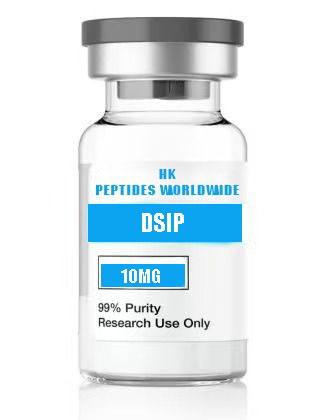
DSIP 10 mg
Research PeptideDocument ID: HKPW-dsip-10-mg-research-peptide-usa-v1.0 | Reviewed by: HKPEPTIDE WORLDWIDE Research Team | Last Updated: 2026-08-08
Product Identity & Specifications
| Parameter | Specification |
|---|---|
| Product Name | Delta Sleep-Inducing Peptide |
| Dosage | 10 mg × 10 vials |
| CAS Number | 62568-57-4 |
| Molecular Formula | C₃₅H₄₈N₁₀O₁₅ |
| Molecular Weight | ~848.8 Da |
| Sequence | Trp-Ala-Gly-Gly-Asp-Ala-Ser-Gly-Glu-OH |
| Purity | ≥99% HPLC |
| Appearance | White to off-white lyophilized powder |
| Solubility | Soluble in sterile water or bacteriostatic water |
| Storage | 2–8°C, desiccated, protected from light |
| Classification | Delta Sleep-Inducing Nonapeptide |
Research Background
DSIP (Delta Sleep-Inducing Peptide) is a nonapeptide first isolated from rabbit cerebral venous blood during electrically-induced slow-wave sleep by Monnier and Schoenenberger in the 1970s. The peptide’s sequence (Trp-Ala-Gly-Gly-Asp-Ala-Ser-Gly-Glu) was found to induce delta wave (0.5-4 Hz) EEG activity characteristic of deep, restorative sleep. Subsequent research expanded DSIP’s profile beyond sleep architecture: it modulates the HPA stress axis (reducing ACTH and corticosterone), produces opioid-independent analgesia, and influences circadian rhythm regulation. Its multifaceted profile — sleep modulation + stress reduction + non-opioid pain modulation — makes it a versatile research tool for studying the neuroendocrine integration of sleep, stress, and pain pathways.
The 10 mg × 10 vials configuration is manufactured under strict quality control protocols. Each batch undergoes HPLC purity verification, ESI-MS identity confirmation, and amino acid analysis. A batch-specific Certificate of Analysis (COA) is included with every order. Bulk and OEM configurations available for qualifying wholesale accounts.
Molecular Mechanisms
Delta Wave EEG Promotion
Slow-wave (0.5-4 Hz) EEG activity enhancement → increased deep sleep duration and sleep efficiency. The mechanism involves modulation of serotonergic and GABAergic tone in sleep-regulating brainstem and hypothalamic nuclei.
HPA Axis Modulation
Reduced ACTH release from anterior pituitary → lower circulating corticosterone → dampened stress axis activity. This effect is particularly relevant in stress-induced sleep disruption models.
Opioid-Independent Analgesia
Pain threshold elevation without μ, δ, or κ opioid receptor binding. The analgesic mechanism involves central serotonin and GABA pathways — a distinct non-opioid pain modulation system. This makes DSIP a valuable tool for studying non-opioid analgesic mechanisms.
Circadian Rhythm Regulation
Influence on suprachiasmatic nucleus (SCN) function and pineal melatonin synthesis → sleep-wake cycle modulation. DSIP’s effects on circadian timing are distinct from its direct sleep-promoting delta wave activity.
Research Applications
- Sleep Architecture & Delta Wave Research
- HPA Axis & Stress Response Studies
- Non-Opioid Analgesia Mechanisms
- Circadian Rhythm Regulation
- Neuroendocrine Integration Research
Comparative Analysis
Compared to Melatonin: Melatonin primarily regulates sleep timing (circadian phase shifting via SCN). DSIP primarily affects sleep depth (delta wave promotion). They target different aspects of sleep physiology and can be studied in complementary protocols. DSIP’s additional stress-modulating and analgesic properties further differentiate its profile from melatonin and other sleep-regulating compounds.
Quality Control & Analytical Specifications
| Parameter | Method | Specification |
|---|---|---|
| Purity | HPLC at 214 nm, C18 column | ≥99.0% peak area |
| Identity (MW) | ESI-MS | ~848.8 Da |
| Appearance | Visual inspection | White to off-white powder |
| Peptide Content | Amino acid analysis | ≥80% net peptide |
| Residual Moisture | Karl Fischer titration | ≤3% |
| Endotoxin | LAL assay | ≤0.5 EU/mg |
Available Configurations
| Configuration | Content | Best For |
|---|---|---|
| Standard Kit | 10 mg × 10 vials × 10 vials | Evaluation; protocol validation |
| Bulk Kit | Custom × 10 vials | Chronic studies; repeat orders |
| OEM/Private Label | Custom | Branded product development |
Frequently Asked Questions
Q: How does DSIP differ from melatonin?
Melatonin: sleep timing (circadian phase). DSIP: sleep depth (delta waves). Melatonin works through MT1/MT2 receptors in the SCN. DSIP works through serotonergic/GABAergic modulation in sleep-regulating nuclei. Complementary — not redundant — research tools.
Q: Does DSIP work through opioid receptors?
No — a key research distinction. DSIP produces analgesia without binding μ, δ, or κ opioid receptors. Its analgesic mechanism involves central serotonin and GABA pathways. This makes DSIP a unique tool for studying non-opioid pain modulation.
Q: What is the origin of DSIP?
DSIP was discovered in the 1970s by Swiss researchers who electrically induced sleep in rabbits, collected cerebral venous blood, and isolated the factor that transferred sleep-inducing activity to recipient animals. The active nonapeptide was identified as Trp-Ala-Gly-Gly-Asp-Ala-Ser-Gly-Glu.
Tiered Wholesale Pricing
| Volume | Discount | For |
|---|---|---|
| 1 kit | List price | Evaluation; competitive analysis |
| 5+ kits | 10% off | Initial portfolio expansion |
| 20+ kits | 20% off | Mid-size distributors |
| 50+ kits | 30% off | Regional distributors |
Contact our team for 100+ kit custom pricing. Mixed-molecule orders qualify for combined volume tiers.
Related Research & Resources
| Resource | Description |
|---|---|
| Healing Regenerative Peptides Hub | Complete research overview & methodology hub |
| Dsip 10 Mg Research Peptide Usa | Related research peptide product |
| Dsip 5 Mg Research Peptide Usa | Related research peptide product |
| Understanding Safety Discussions Around Peptides | Latest research insights & methodology |
View Complete Research Guide »
Compliance Statement
FOR LABORATORY RESEARCH USE ONLY. Not for human or veterinary diagnostic, therapeutic, or prophylactic use. Not a dietary supplement, pharmaceutical ingredient, or approved drug. Researchers must comply with all applicable institutional, local, and national regulations.
© 2026 HKPEPTIDE WORLDWIDE. All rights reserved. Document ID: HKPW-dsip-10-mg-research-peptide-usa-v1.0