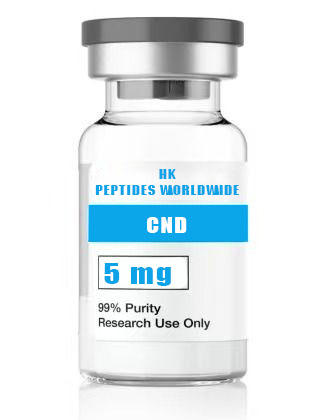
CJC-1295 With DAC (Drug Affinity Complex 5 mg
GHRH Analogue Research PeptideReviewed by: HKPEPTIDE WORLDWIDE Research Team | Last Updated: 2026-08-08 | Document ID: HKPW-cjc-dac-5mg-v2.0
1. Product Identity & Specifications
CJC-1295 With DAC 5 mg is the mid-scale configuration of HKPEPTIDE WORLDWIDE’s long-acting GHRH analogue product line. Designed for chronic somatotroph activation protocols, receptor desensitization studies, systematic DAC/noDAC comparative pharmacology, and multi-day in vitro exposure models, the 5 mg format provides the optimal balance of experimental capacity and cost for laboratories investigating the biological consequences of sustained GHRH receptor occupancy. This DAC-modified tetra-substituted GRF(1-29) amide features the maleimidopropionic acid linker at Lys²⁰ — the structural innovation responsible for its transformative ~8-day plasma half-life (PMID: 15790728).
| Parameter | Specification |
|---|---|
| Product Name | CJC-1295 With DAC (DAC-Modified GRF 1-29) |
| CAS Number | 863288-34-0 |
| Molecular Formula | C₁₆₅H₂₆₉N₄₇O₄₆S₂ (approximate, including DAC linker) |
| Molecular Weight | ~3649 Da |
| Amino Acid Sequence (Core) | Tyr-D-Ala-Asp-Ala-Ile-Phe-Thr-Asn-Ser-Tyr-Arg-Lys-Val-Leu-Ala-Gln-Leu-Ser-Ala-Arg-Lys(DAC)-Leu-Leu-Gln-Asp-Ile-Leu-Ser-Arg-NH₂ |
| DAC Modification | Maleimidopropionic acid (MPA) linker conjugated to Lys²⁰ ε-amine |
| Key Stabilizing Substitutions | D-Ala², Gln⁸, Ala¹⁵, Leu²⁷ |
| Vial Content | 5 mg net peptide |
| Appearance | White to off-white lyophilized powder |
| Purity | ≥99% by HPLC |
| Solubility | Soluble in aqueous buffers (pH 7.4); DMSO for stock solutions |
| Plasma Half-Life | ~8 days (covalent albumin binding) |
| Albumin Binding | Covalent, irreversible (maleimide-thiol conjugation to Cys³⁴) |
| Storage (Lyophilized) | -20°C, protected from light and moisture |
| Storage (Reconstituted) | 2–8°C, use within 30 days |
| Product Grade | Research Use Only (RUO) |
| Peptide Content | ≥85% (net peptide basis) |
2. Research Background
The development of CJC-1295 With DAC represents a landmark achievement in peptide half-life extension technology. ConjuChem Biotechnologies recognized that GRF(1-29) — despite potent GHRH receptor agonism — was clinically constrained by its sub-10-minute plasma half-life. The Drug Affinity Complex (DAC) technology solved this problem through covalent albumin bioconjugation: a maleimidopropionic acid linker that selectively and irreversibly reacts with the single free cysteine (Cys³⁴) on circulating serum albumin, tethering the therapeutic peptide to the most abundant and longest-circulating endogenous protein carrier.
Jetté et al. (2005) demonstrated that CJC-1295-albumin bioconjugates retain full GHRH receptor binding affinity and produce sustained GH and IGF-1 elevations for 6 days following a single injection in rats. Teichman et al. (2006) confirmed translational viability: once-weekly CJC-1295 produced dose-dependent, sustained GH/IGF-1 increases in healthy adults over 7-14 days. For the research community, CJC-1295 With DAC is both a tool for studying sustained vs. pulsatile receptor pharmacology and a model system for albumin-based drug delivery — the 5 mg format enabling systematic multi-day exposure protocols and comprehensive dose-response matrices.
3. Molecular Mechanisms
3.1 DAC Chemistry: Maleimide-Thiol Bioconjugation
The DAC moiety is a maleimidopropionic acid (MPA) linker attached to the ε-amino group of Lys²⁰. The maleimide group reacts selectively with thiol nucleophiles at physiological pH to form a stable thioether bond. Human serum albumin Cys³⁴ (pKa ~8.3) is the predominant reactive plasma thiol; upon injection, CJC-1295 With DAC undergoes rapid, quantitative, irreversible conjugation, generating a CJC-1295-albumin bioconjugate with ~8-day circulating half-life (PMID: 15790728).
3.2 Sustained vs. Pulsatile GHRH-R Activation
Sustained GHRH-R activation produces continuous cAMP elevation and tonic somatotroph stimulation — fundamentally distinct from the physiological pulsatile pattern. This disrupts the ultradian GH rhythm, producing tonic secretion with loss of the amplitude- and frequency-encoded information that normally drives sex-dependent hepatic gene expression, differential STAT5b activation, and tissue-specific IGF-1 production (PMID: 11739333).
3.3 FcRn-Mediated Recycling
The 8-day half-life results from both renal filtration exclusion (~67 kDa albumin vs. ~3.4 kDa free peptide) and FcRn-mediated salvage — albumin internalized by endothelial pinocytosis binds FcRn in acidic endosomes (pH 6.0), diverting it from lysosomal degradation. This recycling mechanism accounts for albumin’s native ~19-day half-life; the CJC-1295 conjugate piggybacks on this pathway.
3.4 Receptor Desensitization Dynamics
The 5 mg format is particularly well-suited for investigating GHRH-R desensitization under sustained ligand exposure — a phenomenon of considerable interest given the clinical observation that continuous GHRH infusion produces diminishing GH responses over time (tachyphylaxis). Systematic time-course experiments (0-96 hours) with periodic cAMP and GH secretion measurements can delineate the kinetics of GRK-mediated phosphorylation, β-arrestin recruitment, and receptor internalization.
4. Research Applications & Focus Areas
The 5 mg CJC-1295 With DAC configuration is ideally suited for:
- Chronic Somatotroph Activation Models: 48-96 hour continuous exposure protocols examining GH secretion dynamics, receptor desensitization, and recovery kinetics
- DAC/noDAC Comparative Pharmacology: Paired experimental designs comparing gene expression profiles (RNA-seq), signaling pathway activation (phospho-proteomics), and receptor trafficking under sustained vs. pulsatile activation
- Albumin Bioconjugate Characterization: Quantitative determination of conjugation efficiency, stability, and receptor pharmacology of the CJC-1295-albumin conjugate using size-exclusion chromatography, SDS-PAGE, and functional assays
- Dose-Response Matrices: Systematic determination of concentration-response relationships for sustained cAMP elevation, GH secretion, and receptor internalization over 24-72 hour exposure periods
- GHRH-R/GHS-R1a Chronic Synergy: Combined sustained GHRH-R activation (With DAC) plus pulsatile GHS-R1a stimulation (GHRP-2/GHRP-6/Ipamorelin) to model integrative somatotroph regulation
5. Quality Control & Analytical Specifications
| Test | Method | Acceptance Criteria |
|---|---|---|
| Purity | RP-HPLC (C18 column, 214 nm) | ≥99.0% |
| Molecular Weight Confirmation | ESI-MS / MALDI-TOF MS | ~3649 ± 1.5 Da |
| Peptide Content | Amino Acid Analysis (AAA) | ≥85.0% |
| Trifluoroacetate (TFA) Content | Ion Chromatography | ≤1.0% |
| Water Content | Karl Fischer Titration | ≤5.0% |
| Endotoxin | LAL Kinetic Chromogenic | ≤1.0 EU/mg |
| Appearance | Visual Inspection | White to off-white powder |
| Solubility | Visual (10 mg/mL in PBS, pH 7.4) | Clear, colorless solution |
| Sequence Verification | LC-MS/MS Peptide Mapping | 100% sequence coverage |
| DAC Integrity | Ellman’s Assay / DTNB Test | Maleimide functionality confirmed |
6. Available Configurations
| Dosage | SKU | Research Application |
|---|---|---|
| 2 mg | HKPW-CJC-DAC-2MG | Pilot studies, sustained activation models, bioconjugation |
| 5 mg | HKPW-CJC-DAC-5MG | Chronic exposure, receptor desensitization, comparative pharmacology |
| 10 mg | HKPW-CJC-DAC-10MG | Extended-duration protocols, multi-arm designs |
7. Tiered Wholesale Pricing
| Quantity | Price Per Vial | SKU |
|---|---|---|
| 1 Vial | $110.00 | HKPW-CJC-DAC-5MG-1 |
| 5 Vials | $98.00/vial ($490 total) | HKPW-CJC-DAC-5MG-5 |
| 10 Vials | $85.00/vial ($850 total) | HKPW-CJC-DAC-5MG-10 |
| 25+ Vials | Contact for bulk pricing | HKPW-CJC-DAC-5MG-BULK |
All prices in USD. Institutional and academic discounts available upon verification.
8. Comparative Analysis: CJC-1295 With DAC vs. Without DAC
| Property | CJC-1295 With DAC | CJC-1295 Without DAC |
|---|---|---|
| CAS Number | 863288-34-0 | N/A |
| Molecular Weight | ~3649 Da | ~3367 Da |
| Plasma Half-Life | ~8 days | ~30 minutes |
| Albumin Binding | Covalent (maleimide-Cys³⁴) | None |
| Receptor Activation Profile | Sustained, continuous | Pulsatile, transient |
| cAMP Signaling Duration | Persistent (days) | Transient (hours) |
| GHRH-R Desensitization | Pronounced | Limited |
| GH Secretion Pattern | Tonic, elevated baseline | Pulsatile, physiological |
| Best Research Fit | Chronic receptor pharmacology | Pulse physiology, acute kinetics |
9. Frequently Asked Questions
Q1: How does the DAC linker bind to albumin?
The maleimidopropionic acid linker at Lys²⁰ undergoes selective Michael addition with the free thiol of albumin Cys³⁴, forming a stable, irreversible thioether bond. This transforms a ~30-minute half-life peptide into an ~8-day half-life bioconjugate.
Q2: Does albumin conjugation affect receptor binding?
No — the conjugate retains full GHRH-R affinity (IC₅₀ ~1.5 nM). The DAC is positioned at Lys²⁰, distal to the N-terminal pharmacophore (residues 1-7), and linker flexibility allows productive receptor engagement.
Q3: What solvent should I use?
For most applications, reconstitute in sterile PBS (pH 7.4). For DAC functionality studies, use degassed buffer at pH 6.5-7.0 immediately before use to preserve maleimide reactivity. For pre-conjugated experiments, incubate with albumin (4:1 molar ratio) for 30 minutes before use.
Q4: What is the advantage of the 5 mg format for chronic exposure studies?
The 5 mg format provides sufficient material for multi-day continuous exposure protocols with daily media changes and endpoint sampling — typical acute exposure studies require 1-2 mg, while chronic 48-96 hour protocols with sampling at multiple time points benefit from the 5 mg quantity.
Q5: Is a Certificate of Analysis provided?
Yes, every shipment includes a batch-specific CoA documenting HPLC purity, mass spectrometry, peptide content, TFA, water content, endotoxin, and DAC integrity.
10. References & Further Reading
- Jetté L, et al. Human GRF(1-29)-albumin bioconjugates: identification of CJC-1295. Endocrinology. 2005;146(7):3052-3058. PMID: 15790728
- Teichman SL, et al. Prolonged stimulation of GH and IGF-I by CJC-1295. J Clin Endocrinol Metab. 2006;91(3):799-805. PMID: 16352682
- Kratz F. Albumin as a drug carrier. J Control Release. 2008;132(3):171-183. PMID: 18582981
- Sleep D, et al. Albumin as a platform for drug half-life extension. Biochim Biophys Acta. 2013;1830(12):5526-5534. PMID: 23639804
- Veldhuis JD, et al. Pulsatile mode of GH secretion. Endocr Rev. 2001;22(6):789-816. PMID: 11739333
- Müller EE, et al. Neuroendocrine control of GH secretion. Physiol Rev. 1999;79(2):511-607. PMID: 10221989
- Andersen JT, et al. Albumin-binding site of the neonatal Fc receptor. Nat Commun. 2012;3:610. PMID: 22215085
- Giustina A, Veldhuis JD. Pathophysiology of GH secretion neuroregulation. Endocr Rev. 1998;19(6):717-797. PMID: 9861545
- Bowers CY, et al. Synthetic hexapeptide that releases growth hormone. Endocrinology. 1984;114(5):1537-1545. PMID: 6425043
- Howard AD, et al. A receptor in pituitary and hypothalamus that functions in growth hormone release. Science. 1996;273(5277):974-977. PMID: 8688086
11. Compliance Statement
This product is manufactured for research purposes only and is not intended for human or veterinary diagnostic, therapeutic, or clinical applications. By purchasing, the buyer affirms that the product will be used exclusively in a qualified research laboratory, by appropriately trained personnel, under all required permits and regulatory approvals. This product is not FDA-approved for human or veterinary use.
12. Internal Links
- CJC-1295 With DAC 2 mg – Pilot & Bioconjugation Studies
- CJC-1295 With DAC 10 mg – Extended-Duration Protocols
- CJC-1295 Without DAC 5 mg – Pulsatile GHRH Research
- CJC-1295 + Ipamorelin Blend – Synergistic Peptide Research
- GHRP-2 Research Peptides – GHS-R1a Agonist Studies
- GHRP-6 Research Peptides – Ghrelin Mimetic Research
- All Research Peptides – Full Catalog
Related Research & Resources
| Resource | Description |
|---|---|
| Healing Regenerative Peptides Hub | Complete research overview & methodology hub |
| Cjc 1295 With Dac 10 Mgin Vitro Research | Related research peptide product |
| Cjc 1295 With Dac 2 Mg Laboratory Resear | Related research peptide product |
| Why Muscle Growth Peptide Research Is Expanding | Latest research insights & methodology |