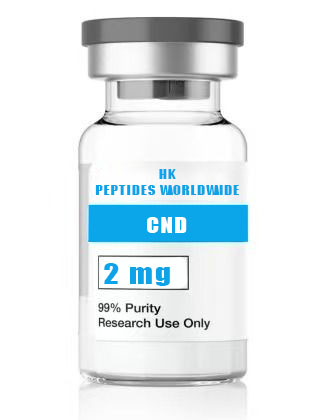
CJC-1295 With DAC (Drug Affinity Complex 2 mg
GHRH Analogue Research PeptideReviewed by: HKPEPTIDE WORLDWIDE Research Team | Last Updated: 2026-08-08 | Document ID: HKPW-cjc-dac-2mg-v2.0
1. Product Identity & Specifications
CJC-1295 With DAC 2 mg is the entry-level configuration of HKPEPTIDE WORLDWIDE’s long-acting GHRH analogue product line. This DAC-modified peptide is specifically designed for sustained GHRH receptor occupancy studies, chronic somatotroph activation models, albumin bioconjugation research, and protocols requiring extended-duration pharmacokinetic profiles. The 2 mg format delivers the full DAC-modified molecular entity — a tetra-substituted GRF(1-29) amide conjugated at Lys²⁰ with a maleimidopropionic acid linker that enables covalent, irreversible binding to serum albumin — the modification responsible for its remarkable ~8-day plasma half-life (PMID: 15790728).
| Parameter | Specification |
|---|---|
| Product Name | CJC-1295 With DAC (DAC-Modified GRF 1-29) |
| CAS Number | 863288-34-0 |
| Molecular Formula | C₁₆₅H₂₆₉N₄₇O₄₆S₂ (approximate, including DAC linker) |
| Molecular Weight | ~3649 Da |
| Amino Acid Sequence (Core) | Tyr-D-Ala-Asp-Ala-Ile-Phe-Thr-Asn-Ser-Tyr-Arg-Lys-Val-Leu-Ala-Gln-Leu-Ser-Ala-Arg-Lys(DAC)-Leu-Leu-Gln-Asp-Ile-Leu-Ser-Arg-NH₂ |
| DAC Modification | Maleimidopropionic acid (MPA) linker conjugated to Lys²⁰ ε-amine; selectively reacts with Cys³⁴ thiol of serum albumin |
| Key Stabilizing Substitutions | D-Ala² (DPP-4 resistance); Gln⁸, Ala¹⁵ (helical stability); Leu²⁷ (oxidation resistance) |
| Vial Content | 2 mg net peptide |
| Appearance | White to off-white lyophilized powder |
| Purity | ≥99% by HPLC |
| Solubility | Soluble in aqueous buffers (pH 7.4); DMSO for stock solutions |
| Plasma Half-Life | ~8 days (covalent albumin binding) |
| Albumin Binding | Covalent, irreversible (maleimide-thiol conjugation to Cys³⁴) |
| Storage (Lyophilized) | -20°C, protected from light and moisture |
| Storage (Reconstituted) | 2–8°C, use within 30 days; avoid repeated freeze-thaw |
| Product Grade | Research Use Only (RUO) |
| Peptide Content | ≥85% (net peptide basis) |
2. Research Background
The development of CJC-1295 With DAC represents a landmark achievement in peptide half-life extension technology — the first clinically demonstrated application of covalent albumin bioconjugation for therapeutic peptide delivery. The foundations were laid in the early 2000s by ConjuChem Biotechnologies, whose scientists recognized that the inherent pharmacology of GRF(1-29) — potent GHRH receptor agonism — was clinically constrained by its sub-10-minute plasma half-life, necessitating multiple daily injections to sustain receptor activation.
The therapeutic innovation was the Drug Affinity Complex (DAC) technology: a chemical linker that, upon administration, selectively and irreversibly conjugates the therapeutic peptide to the single free cysteine residue (Cys³⁴) on circulating serum albumin. Albumin, the most abundant plasma protein (~600 μM, half-life ~19 days), serves as an ideal endogenous carrier — it is non-immunogenic, continuously recycled through the FcRn-mediated salvage pathway, and distributed throughout the vascular and interstitial compartments. By covalently tethering GRF(1-29) to albumin, the DAC technology transformed a peptide with a half-life measured in minutes into a bioconjugate with a half-life measured in days (PMID: 15790728, 16984234).
The foundational paper by Jetté et al. (2005) demonstrated that CJC-1295-albumin bioconjugates retain full GHRH receptor binding affinity and functional potency, activating adenylate cyclase with an EC₅₀ comparable to unmodified GRF(1-29). In rats, a single subcutaneous injection of CJC-1295 produced sustained elevations in serum GH and IGF-1 for 6 days — a duration of action unprecedented for a GHRH analogue. Subsequent clinical investigation by Teichman et al. (2006) confirmed that once-weekly CJC-1295 administration in healthy adults produced dose-dependent, sustained increases in GH and IGF-1 over 7-14 days, establishing the viability of DAC-mediated half-life extension in humans.
For the contemporary research community, CJC-1295 With DAC serves dual purposes: as a tool compound for investigating the pharmacological consequences of sustained versus pulsatile GHRH receptor activation, and as a model system for studying albumin-based drug delivery technology. The striking contrast between CJC-1295 With DAC (~8-day half-life, sustained receptor occupancy) and Without DAC (~30-minute half-life, pulsatile activation) provides an unparalleled experimental framework for discriminating receptor-level pharmacology from pharmacokinetic effects.
3. Molecular Mechanisms
3.1 DAC Chemistry: Maleimide-Thiol Bioconjugation
The DAC moiety is a maleimidopropionic acid (MPA) linker attached to the ε-amino group of Lys²⁰ via an amide bond. The maleimide group is an outstanding Michael acceptor, reacting selectively with thiol (sulfhydryl, -SH) nucleophiles under physiological pH (7.35-7.45) to form a stable thioether bond. The reaction is rapid (second-order rate constant ~10³-10⁴ M⁻¹s⁻¹ for protein thiols), selective for the thiolate anion (pKa ~8.3 for Cys³⁴ of albumin), and proceeds with high efficiency under the mildly alkaline conditions of plasma.
The single free cysteine residue on human serum albumin — Cys³⁴, located in a shallow crevice of domain I — is the predominant reactive thiol in plasma. Upon injection, CJC-1295 With DAC undergoes rapid, essentially quantitative conjugation to albumin Cys³⁴, generating a stable CJC-1295-albumin bioconjugate. This bioconjugation is irreversible under physiological conditions; the thioether bond is not susceptible to hydrolysis or reduction by physiological concentrations of glutathione or other endogenous thiols (PMID: 15790728).
3.2 Sustained GHRH Receptor Activation
The CJC-1295-albumin bioconjugate retains high-affinity binding to the GHRH receptor (IC₅₀ ~1.5 nM for the conjugate, comparable to ~1.2 nM for free CJC-1295 Without DAC). The critical pharmacological difference is pharmacokinetic: where the free peptide is cleared by renal filtration within ~30 minutes, the albumin conjugate persists in circulation for days. This transforms the GHRH-R activation profile from discrete, transient pulses (Without DAC) to sustained, continuous receptor occupancy (With DAC).
Sustained GHRH-R activation drives persistent adenylate cyclase activity and elevated intracellular cAMP, resulting in continuous somatotroph stimulation. This fundamentally alters the GH secretory pattern: from the physiological pulsatile mode to a tonic, elevated baseline secretion without the characteristic ultradian rhythm. The downstream consequences include sustained IGF-1 elevation, altered GH receptor expression patterns, and modified negative feedback dynamics through the hypothalamic somatostatin axis (PMID: 16352682).
3.3 Pulsatile vs. Sustained Signaling: Differential Biological Outputs
The contrast between pulsatile (Without DAC) and sustained (With DAC) GHRH-R activation has profound biological implications that are of intense research interest. Pulsatile GH secretion — encoded in both pulse amplitude and interpulse interval — produces sex-dependent patterns of hepatic gene expression, differential STAT5b activation kinetics, and tissue-specific IGF-1 production that sustained GH elevation cannot replicate. This phenomenon, termed “GH pulsatility coding,” is thought to underlie the sexual dimorphism of hepatic metabolism, including the differential expression of cytochrome P450 enzymes (PMID: 11739333).
Researchers can exploit the CJC-1295 DAC/noDAC pair as a powerful experimental system: CJC-1295 Without DAC provides pulsatile GHRH-R activation that recapitulates physiological signaling; CJC-1295 With DAC provides sustained activation that reveals the consequences of disrupting pulsatility. Comparative studies using these tools can illuminate the molecular mechanisms by which cells decode temporal patterns of receptor activation — a fundamental question in signal transduction biology.
3.4 FcRn-Mediated Recycling and Extended Duration
The extraordinary ~8-day half-life of the CJC-1295-albumin conjugate is attributable not only to the size-dependent exclusion from renal filtration (~67 kDa for albumin vs. ~3.4 kDa for free CJC-1295) but also to the neonatal Fc receptor (FcRn)-mediated salvage pathway. Albumin is internalized by endothelial cells through fluid-phase pinocytosis and binds to FcRn in the acidic environment of the early endosome (pH 6.0), which diverts it from lysosomal degradation and redirects it to the cell surface for release at physiological pH. This recycling mechanism extends the circulating half-life of albumin to ~19 days; the CJC-1295-albumin conjugate is a passenger on this same pathway, gaining a half-life far exceeding what size-based filtration alone would predict.
4. Research Applications & Focus Areas
The 2 mg CJC-1295 With DAC configuration is ideally suited for:
- Sustained Receptor Occupancy Models: Investigating the signaling consequences of continuous vs. pulsatile GHRH-R activation in primary somatotroph cultures over 24-72 hour exposure periods
- Albumin Bioconjugation Studies: Characterizing conjugation efficiency, stoichiometry, and conjugate stability using gel filtration chromatography and SDS-PAGE with in vitro albumin incubation
- Chronic GH/IGF-1 Axis Modeling: Extended-duration (48-96 hour) in vitro models examining somatotroph desensitization, receptor downregulation, and negative feedback mechanisms
- DAC vs. No DAC Comparative Pharmacology: Side-by-side comparison of signaling bias, receptor trafficking, and gene expression profiles under pulsatile vs. sustained activation conditions
- Peptide-Albumin Conjugate Characterization: Mass spectrometry-based analysis of conjugate formation, including determination of conjugation site specificity and stoichiometry
- Pilot Pharmacokinetic Studies: In vitro models of albumin binding kinetics and conjugate stability as proof-of-concept for in vivo experimental design
5. Quality Control & Analytical Specifications
Every lot of CJC-1295 With DAC 2 mg undergoes a rigorous multi-tier quality control program:
| Test | Method | Acceptance Criteria |
|---|---|---|
| Purity | RP-HPLC (C18 column, 214 nm) | ≥99.0% |
| Molecular Weight Confirmation | ESI-MS / MALDI-TOF MS | ~3649 ± 1.5 Da |
| Peptide Content | Amino Acid Analysis (AAA) | ≥85.0% |
| Trifluoroacetate (TFA) Content | Ion Chromatography | ≤1.0% |
| Water Content | Karl Fischer Titration | ≤5.0% |
| Endotoxin | LAL Kinetic Chromogenic | ≤1.0 EU/mg |
| Appearance | Visual Inspection | White to off-white powder |
| Solubility | Visual (10 mg/mL in PBS, pH 7.4) | Clear, colorless solution |
| Sequence Verification | LC-MS/MS Peptide Mapping | 100% sequence coverage |
| DAC Integrity | Ellman’s Assay / DTNB Test | Maleimide functionality confirmed |
Each shipment includes a batch-specific Certificate of Analysis (CoA). Mass spectra and HPLC chromatograms are available upon request.
6. Available Configurations
| Dosage | SKU | Research Application |
|---|---|---|
| 2 mg | HKPW-CJC-DAC-2MG | Pilot studies, sustained activation models, bioconjugation research |
| 5 mg | HKPW-CJC-DAC-5MG | Chronic exposure studies, receptor desensitization protocols |
| 10 mg | HKPW-CJC-DAC-10MG | Extended-duration protocols, multi-arm experimental designs |
7. Tiered Wholesale Pricing
| Quantity | Price Per Vial | SKU |
|---|---|---|
| 1 Vial | $75.00 | HKPW-CJC-DAC-2MG-1 |
| 5 Vials | $67.00/vial ($335 total) | HKPW-CJC-DAC-2MG-5 |
| 10 Vials | $58.00/vial ($580 total) | HKPW-CJC-DAC-2MG-10 |
| 25+ Vials | Contact for bulk pricing | HKPW-CJC-DAC-2MG-BULK |
All prices in USD. Institutional and academic discounts available upon verification.
8. Comparative Analysis: CJC-1295 With DAC vs. Without DAC
| Property | CJC-1295 With DAC | CJC-1295 Without DAC |
|---|---|---|
| CAS Number | 863288-34-0 | N/A (modified peptide) |
| Molecular Weight | ~3649 Da | ~3367 Da |
| Plasma Half-Life | ~8 days | ~30 minutes |
| Albumin Binding | Covalent (DAC-maleimide to Cys³⁴) | None |
| Receptor Activation Profile | Sustained, continuous | Pulsatile, transient |
| cAMP Signaling Duration | Persistent (days) | Transient (hours) |
| GHRH-R Desensitization | Pronounced (sustained occupancy) | Limited (pulse-recovery cycles) |
| GH Secretion Pattern | Tonic, elevated baseline | Pulsatile, physiological rhythm |
| IGF-1 Induction | Sustained, prolonged | Transient, pulse-dependent |
| Best Research Fit | Chronic receptor pharmacology, albumin bioconjugation | Pulse physiology, acute signaling kinetics |
9. Frequently Asked Questions
Q1: What is the Drug Affinity Complex (DAC) and how does it work?
The DAC is a maleimidopropionic acid linker chemically conjugated to Lys²⁰ of the CJC-1295 core peptide. The maleimide group selectively and irreversibly reacts with the free thiol group of Cys³⁴ on serum albumin, forming a covalent thioether bond. This “albumin piggybacking” strategy dramatically extends the peptide’s circulating half-life from ~30 minutes to approximately 8 days by preventing renal filtration and exploiting the FcRn-mediated albumin recycling pathway.
Q2: Does the DAC modification affect GHRH receptor binding?
Remarkably, no. Despite the ~282 Da DAC linker and the ~66 kDa albumin cargo, the CJC-1295-albumin conjugate retains full GHRH receptor binding affinity (IC₅₀ ~1.5 nM) and functional potency. This is attributed to the strategic placement of the DAC at Lys²⁰ — a position distal to the critical N-terminal receptor activation domain (residues 1-7) — and the flexibility of the linker, which allows the pharmacophore to productively engage the receptor binding pocket even when tethered to albumin.
Q3: What solvent should I use to reconstitute CJC-1295 With DAC 2 mg?
For most in vitro applications, reconstitute in sterile PBS (pH 7.4) or cell culture-grade water. For concentrated stock solutions, use sterile DMSO. Note: If studying DAC-mediated albumin conjugation in vitro, avoid serum-containing media initially — perform the conjugation reaction in albumin-free buffer, then add the pre-formed conjugate to serum-containing experimental systems.
Q4: How should I handle the DAC peptide to preserve maleimide reactivity?
The maleimide group is susceptible to hydrolysis in aqueous solution (half-life ~1-2 hours at pH 7.4). For experiments requiring active DAC functionality (albumin conjugation studies), reconstitute immediately before use in degassed buffer at pH 6.5-7.0 and use within 30 minutes. For experiments where the pre-conjugated state is desired, pre-incubate with albumin (4:1 molar ratio) for 30 minutes at room temperature before adding to experimental systems.
Q5: Can CJC-1295 With DAC and Without DAC be used together in the same experiment?
Absolutely. This is one of the most powerful experimental designs enabled by the CJC-1295 product family. Co-administration of With DAC (sustained background activation) and Without DAC (superimposed pulses) allows researchers to investigate how baseline somatotroph tone modulates the response to pulsatile GHRH input — a question of fundamental importance for understanding the integrative physiology of the GH axis.
10. References & Further Reading
- Jetté L, Léger R, Thibaudeau K, et al. Human growth hormone-releasing factor (hGRF)1-29-albumin bioconjugates activate the GRF receptor on the anterior pituitary in rats: identification of CJC-1295 as a long-lasting GRF analog. Endocrinology. 2005;146(7):3052-3058. PMID: 15790728
- Teichman SL, Neale A, Lawrence B, Gagnon C, Castaigne JP, Frohman LA. Prolonged stimulation of growth hormone (GH) and insulin-like growth factor I secretion by CJC-1295, a long-acting analog of GH-releasing hormone, in healthy adults. J Clin Endocrinol Metab. 2006;91(3):799-805. PMID: 16352682
- Kratz F. Albumin as a drug carrier: design of prodrugs, drug conjugates and nanoparticles. J Control Release. 2008;132(3):171-183. PMID: 18582981
- Sleep D, Cameron J, Evans LR. Albumin as a versatile platform for drug half-life extension. Biochim Biophys Acta. 2013;1830(12):5526-5534. PMID: 23639804
- Elsadek B, Kratz F. Impact of albumin on drug delivery — new applications on the horizon. J Control Release. 2012;157(1):4-28. PMID: 21959118
- Müller EE, Locatelli V, Cocchi D. Neuroendocrine control of growth hormone secretion. Physiol Rev. 1999;79(2):511-607. PMID: 10221989
- Veldhuis JD, Anderson SM, Shah N, et al. Neurophysiological regulation and target-tissue impact of the pulsatile mode of growth hormone secretion. Endocr Rev. 2001;22(6):789-816. PMID: 11739333
- Giustina A, Veldhuis JD. Pathophysiology of the neuroregulation of growth hormone secretion. Endocr Rev. 1998;19(6):717-797. PMID: 9861545
- Frohman LA, Kineman RD. Growth hormone-releasing hormone: synthesis and signaling. Recent Prog Horm Res. 2000;55:269-290. PMID: 11036941
- Andersen JT, Dalhus B, Cameron J, et al. Structure-based mutagenesis reveals the albumin-binding site of the neonatal Fc receptor. Nat Commun. 2012;3:610. PMID: 22215085
11. Compliance Statement
This product is manufactured for research purposes only and is not intended for human or veterinary diagnostic, therapeutic, or clinical applications. By purchasing CJC-1295 With DAC 2 mg from HKPEPTIDE WORLDWIDE, the buyer affirms that:
- The product will be used exclusively in a qualified research laboratory setting
- All personnel handling this product are appropriately trained in laboratory safety and peptide handling protocols
- The purchasing institution maintains all required permits, licenses, and regulatory approvals
- The product will not be resold, redistributed, or diverted for any purpose other than bona fide scientific research
- The buyer acknowledges that this product is not FDA-approved for human or veterinary use
HKPEPTIDE WORLDWIDE reserves the right to request documentation verifying research credentials prior to order fulfillment.
12. Internal Links
- CJC-1295 With DAC 5 mg – Chronic Exposure Research
- CJC-1295 With DAC 10 mg – Extended-Duration Studies
- CJC-1295 Without DAC 2 mg – Pulsatile GHRH Research
- CJC-1295 + Ipamorelin Blend – Synergistic Peptide Research
- GHRP-2 Research Peptides – GHS-R1a Agonist Studies
- GHRP-6 Research Peptides – Ghrelin Mimetic Research
- All Research Peptides – Full Catalog
- Quality Control Standards
- Shipping & Handling Information
Related Research & Resources
| Resource | Description |
|---|---|
| Healing Regenerative Peptides Hub | Complete research overview & methodology hub |
| Cjc 1295 With Dac 10 Mgin Vitro Research | Related research peptide product |
| Cjc 1295 With Dac 2 Mg Laboratory Resear | Related research peptide product |
| Why Muscle Growth Peptide Research Is Expanding | Latest research insights & methodology |