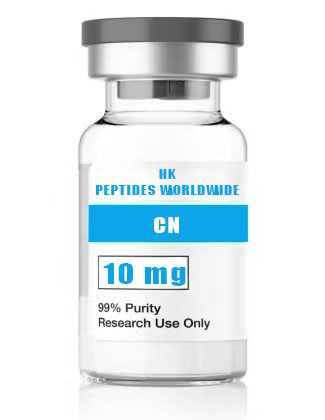
CJC-1295 With DAC (Drug Affinity Comple 10 mg
GHRH Analogue Research PeptideReviewed by: HKPEPTIDE WORLDWIDE Research Team | Last Updated: 2026-08-08 | Document ID: HKPW-cjc-dac-10mg-v2.0
1. Product Identity & Specifications
CJC-1295 With DAC 10 mg is the maximum-quantity configuration in HKPEPTIDE WORLDWIDE’s long-acting GHRH analogue product line. Engineered for high-volume research laboratories conducting comprehensive sustained receptor occupancy studies, multi-arm chronic exposure protocols, and large-scale albumin bioconjugation research, the 10 mg format provides the largest single-vial quantity of this uniquely engineered peptide. With its ~8-day plasma half-life — achieved through covalent, irreversible albumin binding via the maleimidopropionic acid (DAC) linker at Lys²⁰ — CJC-1295 With DAC represents a paradigm-shifting approach to peptide half-life extension and sustained GPCR pharmacology.
| Parameter | Specification |
|---|---|
| Product Name | CJC-1295 With DAC (DAC-Modified GRF 1-29) |
| CAS Number | 863288-34-0 |
| Molecular Formula | C₁₆₅H₂₆₉N₄₇O₄₆S₂ (approximate) |
| Molecular Weight | ~3649 Da |
| Amino Acid Sequence (Core) | Tyr-D-Ala-Asp-Ala-Ile-Phe-Thr-Asn-Ser-Tyr-Arg-Lys-Val-Leu-Ala-Gln-Leu-Ser-Ala-Arg-Lys(DAC)-Leu-Leu-Gln-Asp-Ile-Leu-Ser-Arg-NH₂ |
| DAC Modification | Maleimidopropionic acid (MPA) linker at Lys²⁰ ε-amine |
| Key Stabilizing Substitutions | D-Ala² (DPP-4 resistance); Gln⁸, Ala¹⁵ (helical stability); Leu²⁷ (oxidation resistance) |
| Vial Content | 10 mg net peptide |
| Appearance | White to off-white lyophilized powder |
| Purity | ≥99% by HPLC |
| Solubility | Soluble in aqueous buffers (pH 7.4); DMSO for stock solutions |
| Plasma Half-Life | ~8 days (covalent albumin binding) |
| Albumin Binding | Covalent, irreversible (maleimide-thiol conjugation to albumin Cys³⁴) |
| Storage (Lyophilized) | -20°C, protected from light and moisture |
| Storage (Reconstituted) | 2–8°C, use within 30 days |
| Product Grade | Research Use Only (RUO) |
| Peptide Content | ≥85% (net peptide basis) |
2. Research Background
CJC-1295 With DAC represents a landmark achievement in peptide half-life extension — the first clinically demonstrated application of covalent albumin bioconjugation for therapeutic peptide delivery. ConjuChem Biotechnologies developed the Drug Affinity Complex (DAC) technology to address the fundamental limitation of GRF(1-29): potent GHRH receptor agonism constrained by a sub-10-minute plasma half-life. The DAC linker — a maleimidopropionic acid moiety conjugated to Lys²⁰ — exploits albumin’s unique biology: as the most abundant plasma protein (~600 μM) with a ~19-day half-life, albumin serves as an ideal endogenous carrier. The maleimide group selectively and irreversibly reacts with albumin’s single free cysteine (Cys³⁴), forming a covalent thioether bond that tethers the therapeutic peptide to this long-circulating carrier.
Jetté et al. (2005) provided the foundational demonstration: CJC-1295-albumin bioconjugates retain full GHRH receptor binding affinity (IC₅₀ ~1.5 nM) and produce sustained GH/IGF-1 elevations for 6 days following a single injection in rats. Teichman et al. (2006) confirmed clinical viability with once-weekly dosing producing sustained GH/IGF-1 increases over 7-14 days in healthy adults. The 10 mg format enables the most ambitious research designs — multi-week chronic exposure protocols, systematic DAC/noDAC comparative transcriptomics, and comprehensive structure-activity relationship studies across the CJC-1295/GHRP peptide family.
3. Molecular Mechanisms
3.1 DAC Chemistry and Albumin Bioconjugation
The maleimidopropionic acid linker at Lys²⁰ is an outstanding Michael acceptor, reacting selectively with thiolate anions at physiological pH to form stable thioether bonds. Albumin Cys³⁴ (pKa ~8.3) is the predominant reactive plasma thiol. The conjugation is rapid (k₂ ~10³-10⁴ M⁻¹s⁻¹), quantitative, and irreversible under physiological conditions. The resulting CJC-1295-albumin bioconjugate (~70 kDa) is excluded from renal filtration and recycled via the FcRn salvage pathway, achieving the ~8-day half-life.
3.2 Sustained GHRH Receptor Pharmacology
The CJC-1295-albumin conjugate maintains high-affinity GHRH-R binding and drives persistent adenylate cyclase activation — a pharmacological profile fundamentally distinct from the pulsatile activation produced by CJC-1295 Without DAC. This sustained receptor occupancy produces tonic GH secretion, sustained IGF-1 elevation, and progressive receptor desensitization — phenomena of intense research interest for understanding GPCR signaling dynamics and the biological coding of temporal hormone patterns.
3.3 Pulsatility Coding and Differential Gene Expression
The 10 mg format enables the most comprehensive investigations of “GH pulsatility coding” — the phenomenon whereby the temporal pattern of GH secretion (pulse amplitude, frequency, and interpulse interval) encodes information that produces qualitatively different biological outputs compared to tonic GH elevation. Comparative transcriptomic and phospho-proteomic analyses of cells exposed to pulsatile (Without DAC) vs. sustained (With DAC) GHRH-R activation can reveal the molecular basis of this temporal signal decoding — a fundamental question with implications extending beyond endocrinology to neuroscience, immunology, and circadian biology (PMID: 11739333).
4. Research Applications & Focus Areas
The 10 mg CJC-1295 With DAC configuration supports:
- Comprehensive Chronic Exposure Protocols: Multi-week sustained activation studies with daily sampling for GH secretion, cAMP dynamics, and receptor trafficking endpoints
- Systematic DAC/noDAC Comparative Omics: Paired RNA-seq, phospho-proteomic, and metabolomic profiling of cells under sustained vs. pulsatile GHRH-R activation
- Multi-Analogue Pharmacology Panels: Head-to-head comparison of CJC-1295 With DAC, Without DAC, Sermorelin, Tesamorelin, and custom GHRH analogues in identical chronic exposure conditions
- Albumin Bioconjugation Optimization: Systematic investigation of conjugation conditions (pH, temperature, molar ratio, time) and conjugate characterization by SEC-MALS, SDS-PAGE, and functional assay
- GHRH-R/GHS-R1a Chronic Synergy Matrices: Combined sustained GHRH-R activation with varied GHS-R1a stimulation patterns to map the integrative somatotroph regulatory landscape
- Longitudinal In Vivo Protocols: The 10 mg quantity supports extended in vivo studies under IACUC-approved protocols with sufficient material for complete experimental cohorts
5. Quality Control & Analytical Specifications
| Test | Method | Acceptance Criteria |
|---|---|---|
| Purity | RP-HPLC (C18 column, 214 nm) | ≥99.0% |
| Molecular Weight Confirmation | ESI-MS / MALDI-TOF MS | ~3649 ± 1.5 Da |
| Peptide Content | Amino Acid Analysis (AAA) | ≥85.0% |
| TFA Content | Ion Chromatography | ≤1.0% |
| Water Content | Karl Fischer Titration | ≤5.0% |
| Endotoxin | LAL Kinetic Chromogenic | ≤1.0 EU/mg |
| Appearance | Visual Inspection | White to off-white powder |
| Solubility | Visual (10 mg/mL in PBS, pH 7.4) | Clear, colorless solution |
| Sequence Verification | LC-MS/MS Peptide Mapping | 100% sequence coverage |
| DAC Integrity | Ellman’s Assay / DTNB Test | Maleimide functionality confirmed |
6. Available Configurations
| Dosage | SKU | Research Application |
|---|---|---|
| 2 mg | HKPW-CJC-DAC-2MG | Pilot studies, bioconjugation research |
| 5 mg | HKPW-CJC-DAC-5MG | Chronic exposure, receptor desensitization |
| 10 mg | HKPW-CJC-DAC-10MG | Extended-duration protocols, comprehensive studies |
7. Tiered Wholesale Pricing
| Quantity | Price Per Vial | SKU |
|---|---|---|
| 1 Vial | $165.00 | HKPW-CJC-DAC-10MG-1 |
| 5 Vials | $148.00/vial ($740 total) | HKPW-CJC-DAC-10MG-5 |
| 10 Vials | $128.00/vial ($1,280 total) | HKPW-CJC-DAC-10MG-10 |
| 25+ Vials | Contact for bulk pricing | HKPW-CJC-DAC-10MG-BULK |
All prices in USD. Institutional and academic discounts available upon verification.
8. Comparative Analysis
| Property | CJC-1295 With DAC | CJC-1295 Without DAC |
|---|---|---|
| CAS Number | 863288-34-0 | N/A |
| Molecular Weight | ~3649 Da | ~3367 Da |
| Plasma Half-Life | ~8 days | ~30 minutes |
| Albumin Binding | Covalent (maleimide-Cys³⁴) | None |
| Receptor Activation | Sustained, continuous | Pulsatile, transient |
| GH Secretion Pattern | Tonic | Pulsatile, physiological |
| GHRH-R Desensitization | Pronounced | Limited |
| Best Research Fit | Chronic pharmacology, bioconjugation | Pulse physiology, acute kinetics |
9. Frequently Asked Questions
Q1: How does the DAC linker work?
The maleimidopropionic acid linker at Lys²⁰ selectively and irreversibly reacts with the free thiol of albumin Cys³⁴, forming a stable thioether bond. This covalent bioconjugation transforms a ~30-minute half-life peptide into an ~8-day half-life bioconjugate.
Q2: Does albumin conjugation affect receptor binding?
No — the conjugate retains full affinity (IC₅₀ ~1.5 nM). DAC placement at Lys²⁰ preserves the N-terminal pharmacophore, and linker flexibility enables productive receptor engagement.
Q3: What solvent should I use?
For most applications: sterile PBS (pH 7.4). For DAC functionality studies: degassed buffer at pH 6.5-7.0 immediately before use. For pre-conjugated experiments: pre-incubate with albumin (4:1) for 30 min.
Q4: Why choose 10 mg over smaller formats?
The 10 mg format supports the most ambitious experimental designs: multi-week chronic exposure protocols, comprehensive omics studies (RNA-seq, phospho-proteomics), multi-analogue comparative pharmacology panels, and extended in vivo protocols — all from a single, well-characterized lot.
Q5: Is a Certificate of Analysis provided?
Yes. Every shipment includes a batch-specific CoA with full analytical documentation.
10. References & Further Reading
- Jetté L, et al. Human GRF(1-29)-albumin bioconjugates: identification of CJC-1295. Endocrinology. 2005;146(7):3052-3058. PMID: 15790728
- Teichman SL, et al. Prolonged stimulation of GH and IGF-I by CJC-1295. J Clin Endocrinol Metab. 2006;91(3):799-805. PMID: 16352682
- Kratz F. Albumin as a drug carrier. J Control Release. 2008;132(3):171-183. PMID: 18582981
- Sleep D, et al. Albumin for drug half-life extension. Biochim Biophys Acta. 2013;1830(12):5526-5534. PMID: 23639804
- Veldhuis JD, et al. Pulsatile mode of GH secretion. Endocr Rev. 2001;22(6):789-816. PMID: 11739333
- Müller EE, et al. Neuroendocrine control of GH secretion. Physiol Rev. 1999;79(2):511-607. PMID: 10221989
- Andersen JT, et al. Albumin-binding site of FcRn. Nat Commun. 2012;3:610. PMID: 22215085
- Howard AD, et al. GHS-R: a receptor for growth hormone release. Science. 1996;273(5277):974-977. PMID: 8688086
- Kojima M, et al. Ghrelin is a GH-releasing acylated peptide. Nature. 1999;402(6762):656-660. PMID: 10604470
- Bowers CY, et al. Synthetic hexapeptide GH secretagogue. Endocrinology. 1984;114(5):1537-1545. PMID: 6425043
11. Compliance Statement
This product is manufactured for research purposes only and is not intended for human or veterinary diagnostic, therapeutic, or clinical applications. By purchasing, the buyer affirms exclusive use in qualified research laboratories by trained personnel under all required permits. This product is not FDA-approved for human or veterinary use.
12. Internal Links
- CJC-1295 With DAC 2 mg – Pilot & Bioconjugation Studies
- CJC-1295 With DAC 5 mg – Chronic Exposure Studies
- CJC-1295 Without DAC 10 mg – Pulsatile GHRH Research
- CJC-1295 + Ipamorelin Blend – Synergistic Peptide Research
- GHRP-2 Research Peptides – GHS-R1a Agonist Studies
- GHRP-6 Research Peptides – Ghrelin Mimetic Research
- All Research Peptides – Full Catalog
Related Research & Resources
| Resource | Description |
|---|---|
| Healing Regenerative Peptides Hub | Complete research overview & methodology hub |
| Cjc 1295 With Dac 10 Mgin Vitro Research | Related research peptide product |
| Cjc 1295 With Dac 2 Mg Laboratory Resear | Related research peptide product |
| Why Muscle Growth Peptide Research Is Expanding | Latest research insights & methodology |